Why Your Jaw Clenches the Moment You Try to Relax

Quick Answer: Your jaw was already tense - stillness just removed the distraction hiding it. Clenching is a low-grade protective response tied to vigilance, and it tends to surface the moment your attention turns inward. The fastest release is tongue to the roof of the mouth with teeth apart and lips closed, held for two minutes, combined with a long slow exhale.
You sit down to meditate, or you lie down to sleep, and within ninety seconds your back teeth are touching and your jaw feels like a fist. It reads as evidence that relaxing does not work for you. It is actually evidence that your jaw has been doing this all day and you were too busy to notice.

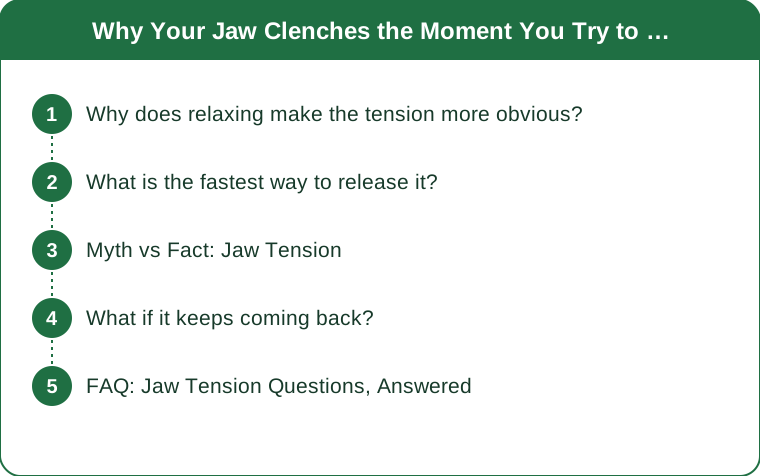
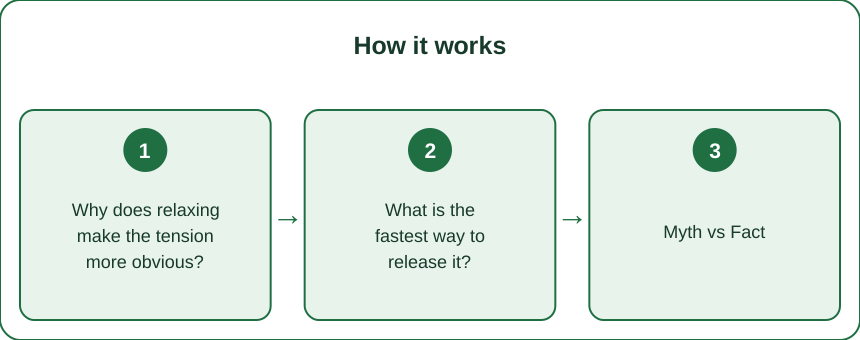
Why does relaxing make the tension more obvious?
Because attention is a limited resource and low-grade muscle tension does not compete well for it.
During the day you have a constant stream of external input - screens, conversation, tasks, noise. That input occupies the same attentional bandwidth that would otherwise notice a sensation like a slightly clenched jaw. The tension is present the whole time. It just is not loud enough to win.
Remove the input and the sensation is suddenly the loudest thing in the room. This is why so many people conclude that meditation makes them tense - it does not create tension, it reveals it, which is genuinely disorienting the first few times.
There is a second mechanism. The jaw muscles, particularly the masseter, are involved in a protective response. When your nervous system is running slightly vigilant - the low simmer that a busy period produces - the jaw is one of the places that holds. Turning attention inward often produces a brief uptick in vigilance in people who are not used to it, because you are removing your usual coping activity, and the jaw responds accordingly.
The third factor is simple habit. The masseter is one of the strongest muscles in the body relative to its size, and it is capable of sustaining low-level contraction for hours without fatiguing enough to complain. A pattern held that long becomes the resting default, and the muscle does not know it is supposed to let go.
What is the fastest way to release it?
The single most effective position takes about ten seconds to learn and two minutes to work.
The tongue position. Rest the tip and the front third of your tongue against the roof of your mouth, just behind your front teeth. Keep your lips gently closed and your back teeth apart - there should be a small gap between the upper and lower molars. This is the anatomical rest position of the jaw, and it is mechanically difficult to clench from it. Hold for two minutes.
Add the exhale. Breathe in for four through your nose, out for six to eight through slightly parted lips. The long exhale engages the parasympathetic response, and it also physically prevents clenching while you do it. Six rounds.
Then the physical release. Place two fingers on each masseter - the muscle you feel bulge when you bite down, at the angle of the jaw below the cheekbone. Press with moderate pressure and make small slow circles for thirty seconds each side. Then let the jaw hang open loosely for ten seconds. Repeat twice.
And the warm compress if the tension is severe. A warm flannel held against both sides of the jaw for five minutes before bed increases blood flow and shortens the release time considerably.
Do it before you meditate, not during. If the clenching consistently derails your practice, spend two minutes releasing first, and start the session from a jaw that has already let go. Trying to release it mid-session usually means spending the whole session monitoring your jaw.

Myth vs Fact: Jaw Tension
Myth: Jaw clenching means you are stressed. Fact: It correlates with stress but is not a reliable readout of it. Sleep position, an unbalanced bite, caffeine, and simple habit all produce clenching in people who feel fine. Treat it as one signal among several, not a verdict.
Myth: If you notice it, you can just stop. Fact: You can stop for the ninety seconds you are paying attention. The pattern re-establishes as soon as your attention moves. That is why a physical rest position works better than a mental instruction.
Myth: A mouthguard fixes it. Fact: A guard protects your teeth from the damage, which is genuinely valuable, but does not stop the muscle activity itself. It is protection rather than treatment - which is fine, as long as you know which one you are getting.
Myth: Only night grinding matters. Fact: Daytime clenching is extremely common and often the larger contributor to jaw and temple aching, because it runs for so many hours. Night grinding tends to produce more tooth wear; day clenching produces more muscle pain.
Myth: It is just a jaw problem. Fact: Jaw tension travels. Tension headaches at the temples, aching behind the eyes, neck stiffness, and ear fullness with no infection are all commonly linked. This is the part that surprises people most - the headache they have been treating for months resolves when the jaw does.
What if it keeps coming back?
A two-minute release works on the current episode. Stopping the pattern needs a few things running in the background.
Set an environmental cue. Pick something that happens many times a day - your phone unlocking, a doorway, a notification - and use it as a jaw check. Teeth apart, tongue up, shoulders down. Three seconds. The point is frequency, not depth, because you are trying to overwrite a default rather than treat an episode.
Look at the last two hours before bed. Caffeine after mid-afternoon, alcohol in the evening, and screen use right up to lights out are all associated with more nocturnal clenching. Alcohol in particular fragments sleep in the second half of the night, which is when grinding tends to increase.
Check your daytime posture. A forward head position - which is what a laptop at desk height produces - changes the resting load on the jaw and neck muscles. Raising the screen so the top of it is at eye level does more for jaw tension than most people expect.
Stop chewing gum for two weeks if you chew it regularly. It keeps the masseter in a state of near-constant work and makes everything else you are doing harder.
And see a dentist or doctor if: you are waking with jaw pain most mornings, your jaw clicks and locks or catches when you open it, you notice teeth becoming flatter or more sensitive, or the pain is one-sided and getting worse. Those point toward something that needs assessing rather than releasing - a bite issue, a joint problem, or bruxism that warrants a guard. This is general information, not medical advice.
FAQ: Jaw Tension Questions, Answered
Why does my jaw clench when I meditate?
Because meditation removes the external input that was occupying your attention, so tension already present becomes noticeable. It is being revealed, not created.
How do you relax a clenched jaw quickly?
Tongue to the roof of your mouth, back teeth apart, lips closed, held for two minutes, with slow exhales roughly twice as long as your inhales. Add thirty seconds of circular massage on the masseter at each side of the jaw.
Is jaw clenching a sign of anxiety?
It is often associated with it, but not exclusively. Sleep position, caffeine, bite alignment, and plain habit all cause clenching too. Persistent morning pain, clicking, or locking is worth having assessed by a dentist.
TL;DR:
- Stillness reveals jaw tension that was already there - it does not cause it.
- Tongue up, teeth apart, lips closed for two minutes is the fastest reliable release.
- Long exhales and thirty seconds of masseter massage speed it up considerably.
- Use a frequent daily cue to check in, and see a dentist for morning pain, clicking, or locking.
If your jaw tightens the moment you sit down quietly, that is not a sign the quiet is not working. It is the first honest measurement you have taken all day.
Keep Reading
This article is for general informational and styling purposes only. Fit, sizing, and product availability may vary.