Why Your Breath Gets Shallow When You Check Your Phone

Quick Answer: Checking your phone often makes your breathing shallow and fast without you noticing. Attention pulls the breath up into the chest, and small alerts keep the body in a mild state of alert. Three quick resets, a slower exhale, a phone-free moment after each check, and a simple notification plan, can help you feel calmer within a few days.
You reach for your phone to look at one message, and twenty minutes later your shoulders are up near your ears and your breath feels like it is stuck high in your chest. That is not a coincidence. Your body is responding to how you are using your attention.

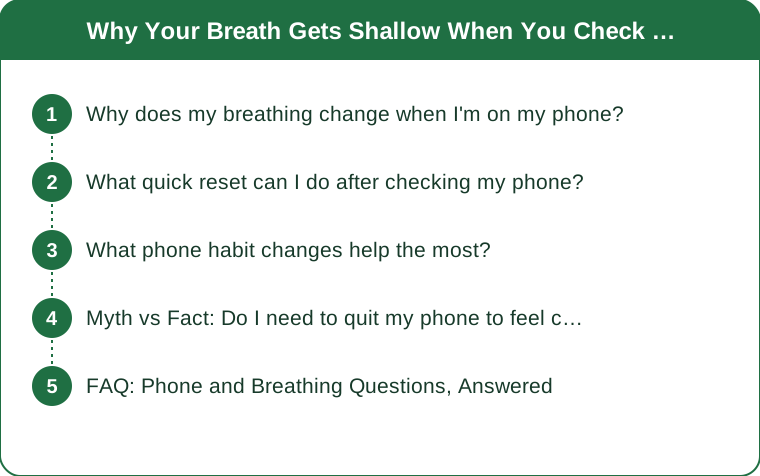
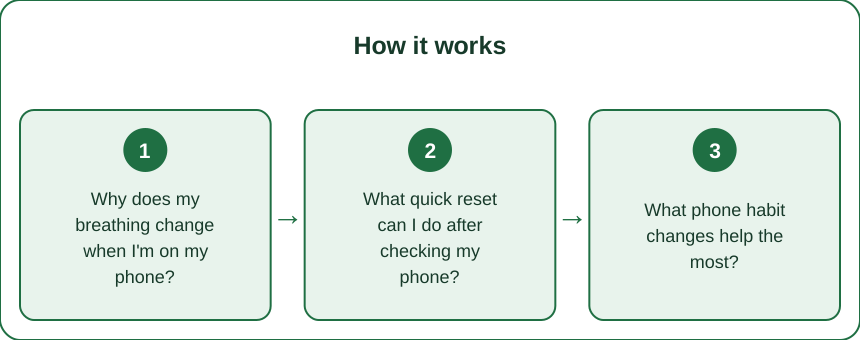
Why does my breathing change when I’m on my phone?
When you focus on a screen, you tend to hold your breath briefly, breathe through the chest, and forget to exhale fully. Each new notification adds a tiny jolt of attention. Over time, that pattern teaches the body to stay slightly braced and quick.
The effect is subtle, which is why it is easy to miss. You may only notice it when you put the phone down and realize your jaw and shoulders are tight.
What quick reset can I do after checking my phone?
Try the long exhale reset. Breathe in gently through your nose for a count of four, then breathe out slowly through your mouth for a count of six or eight. Repeat for six breaths.
Then do a quick body scan. Notice your jaw, shoulders, and belly, and let each one soften a little on the exhale. The whole reset takes under a minute and works well in a waiting room, before a meeting, or in the car.

What phone habit changes help the most?
Set a few simple boundaries. Turn off non-urgent notifications, keep the phone out of the bedroom at night, and give yourself one phone-free moment after each check. Stand up, look out a window, or take three breaths before you pick up the next task.
These small changes work because they interrupt the loop. You are not trying to be perfect. You are just giving your nervous system a chance to reset more often.
Myth vs Fact: Do I need to quit my phone to feel calmer?
Myth: You have to delete every app to feel better. Fact: Most people do well with a few smart changes, not a full digital detox.
Fact: Choosing when you check, and pausing before you start scrolling, usually creates more calm than a complete break. Start with one habit and build from there.
FAQ: Phone and Breathing Questions, Answered
Is shallow breathing a sign of anxiety?
It can be. Shallow breathing often shows up when people feel stressed or alert, but many other things can cause it too. If it is frequent or comes with chest pain or dizziness, talk with a doctor.
How often should I do the reset?
Try it after any check that leaves you feeling tense. Doing it three or four times a day is a good starting point.
Will this help with sleep?
Often, yes. A slow exhale before bed signals the body to slow down, and a phone-free evening helps even more.
TL;DR:
- Phone checks can make breathing shallow and quick without you noticing.
- Use the long exhale reset: in for four, out for six or eight, six breaths.
- Add a quick body scan to let the jaw and shoulders soften.
- Turn off non-urgent alerts and keep a phone-free moment after each check.
- Talk with a doctor if shallow breathing comes with chest pain or dizziness.
You do not have to give up your phone to breathe better. A few small pauses, placed where the habit lives, can change how the whole day feels. This is general information, not medical advice.
Keep Reading
This article is for general informational and styling purposes only. Fit, sizing, and product availability may vary.