Why Your Heart Pounds When You Lie Down at Night

Quick Answer: Your heart seems to pound when you lie down at night mainly because the room is finally quiet and still, so you notice a heartbeat you ignored all day. Lying on your left side, late caffeine, alcohol, a heavy dinner and leftover stress can all make it stronger. Roll onto your right side or your back, breathe in for 4 counts and out for 6 for about 3 minutes, and cut caffeine after noon. See a doctor if it comes with chest pain, breathlessness, fainting, or an irregular rhythm.
You got through the whole day without a problem. Emails, errands, dinner, done.
Then you turn off the lamp, put your head on the pillow, and there it is. Thump, thump, thump, loud enough that you can hear it in your ear. Now you’re wide awake, listening to your own chest and wondering what’s wrong.

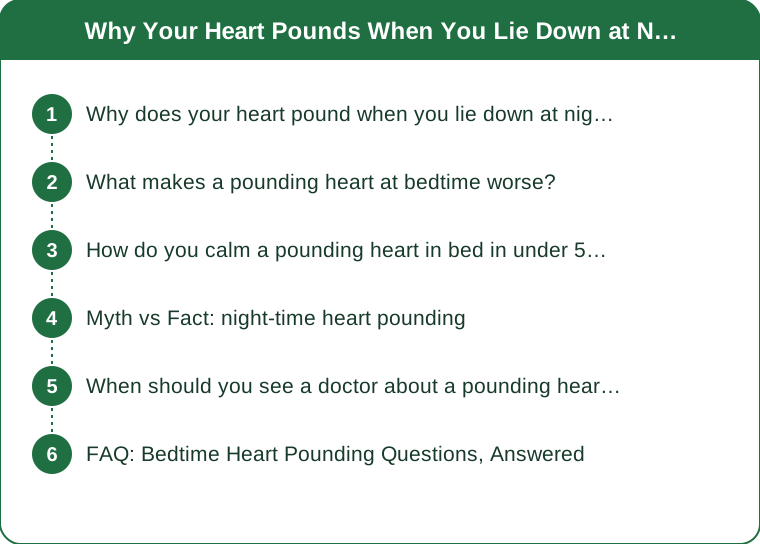
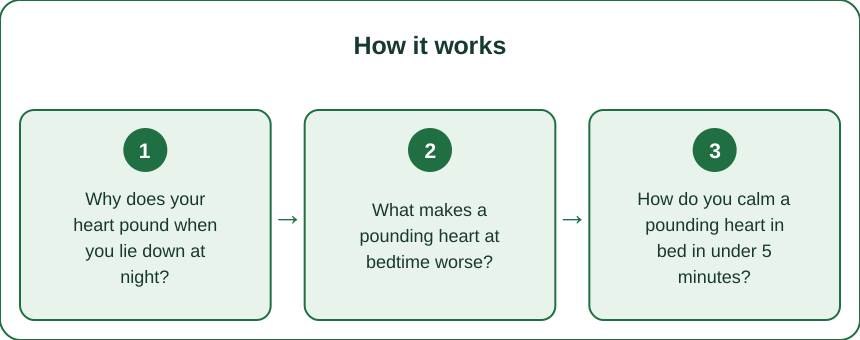
Why does your heart pound when you lie down at night?
In most cases your heart is doing what it did all day. What changed is how much of it you can perceive.
During the day your attention is taken up by sound, movement and tasks. At night all of that drops away. In a silent, dark room, your heartbeat is one of the few things left to notice.
Position plays a part too. When you lie on your left side, your heart sits closer to the chest wall, and many people feel each beat more clearly. With an ear pressed into the pillow, you may hear your pulse as well.
Then a loop begins. You notice the beat, you wonder whether it’s normal, that worry releases a little adrenaline, and adrenaline makes the heart beat harder and faster. Now there really is more to notice.
So a sensation that started as ordinary awareness can become a real pounding within a minute or two.
What makes a pounding heart at bedtime worse?
Several everyday things turn the volume up.
Late caffeine. Caffeine’s half-life is about 5 to 6 hours in most adults, so half of a 3pm coffee is still in your system at 9pm. Tea, cola, energy drinks and dark chocolate count too.
Alcohol. A drink or two in the evening can raise your resting heart rate for several hours, and it’s a common trigger for night-time palpitations.
A large or late dinner. Digestion increases blood flow to your gut, and lying down on a full stomach can cause reflux. Both can make your heartbeat more noticeable.
Stress you didn’t deal with. If you kept busy all day, bedtime is the first moment your nervous system has to process it.
Dehydration. With less fluid on board, your heart works a little harder to move blood around.
Hormonal shifts. Many women notice more palpitations before a period, during pregnancy, and through perimenopause.
Some medications. Decongestants and certain asthma inhalers are known for this. Ask your pharmacist if you’re unsure.
How do you calm a pounding heart in bed in under 5 minutes?
Work through these in order. Most people settle by the second or third step.
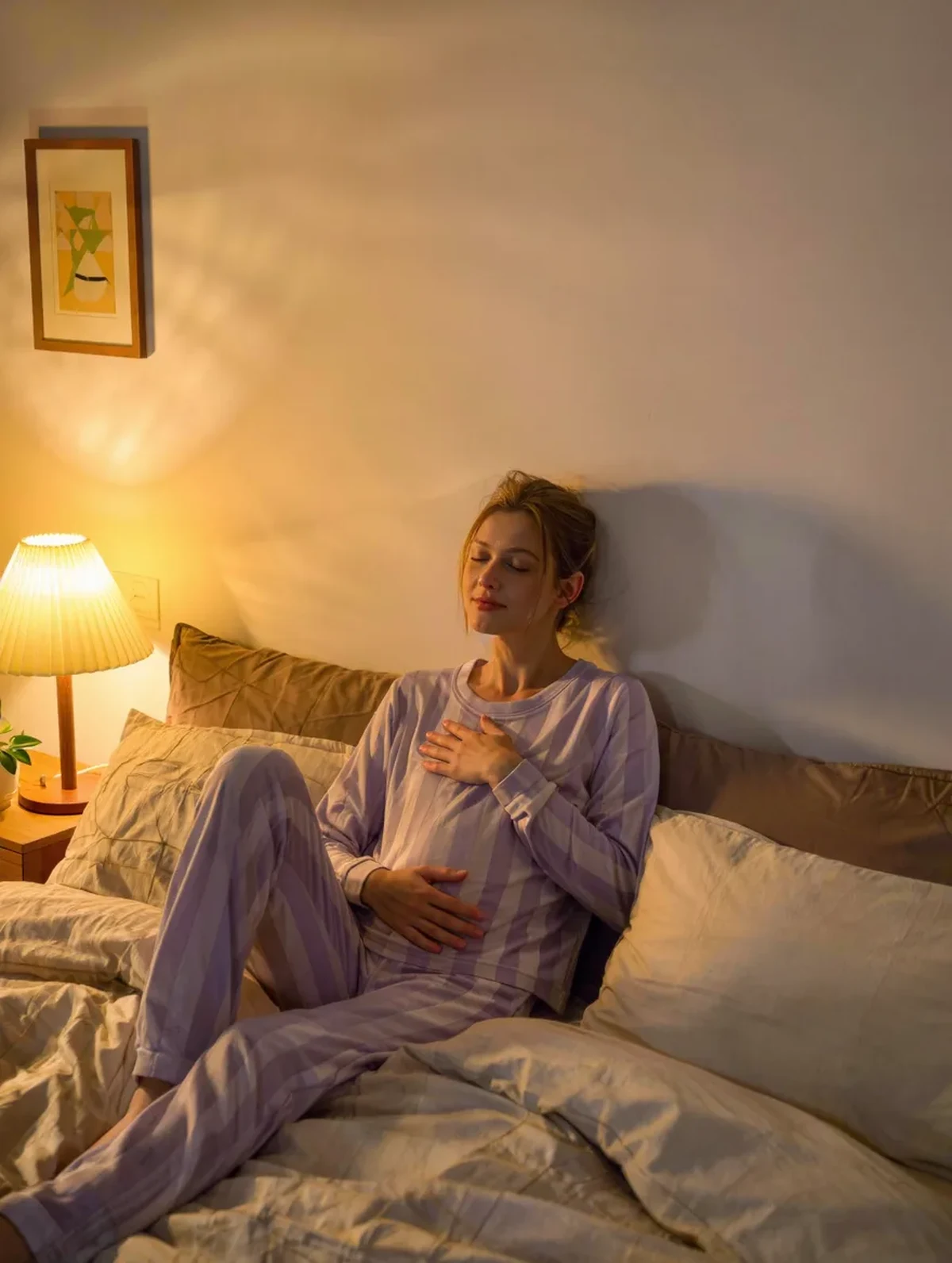
- Change position. Roll onto your right side or your back and add a second pillow so your head and chest are slightly raised.
- Lengthen your exhale. Breathe in through your nose for 4 counts and out through your mouth for 6, as if you’re slowly fogging a window. Keep going for about 3 minutes, roughly 18 breaths. A long exhale activates the part of your nervous system that slows the heart.
- Put a hand on your belly. Feel it rise on the inhale and fall on the exhale. This gives your attention a job other than monitoring your chest.
- Cool down. Push the covers off your feet or take a few sips of cool water.
- Name it. Say to yourself, quietly, that this is adrenaline and it will pass in a few minutes. It sounds too simple, and it does interrupt the worry loop.
If you’re still wired after 20 minutes, get up, sit somewhere dim, and read something dull until you feel sleepy.
Myth vs Fact: night-time heart pounding
Myth: if you can feel your heart beating, something must be wrong with it.
Fact: being aware of your heartbeat when you’re lying still in a quiet room is extremely common and usually harmless.
Myth: deep breaths as big as you can manage are the answer.
Fact: huge fast breaths can make you dizzy and more anxious. What matters is a slow exhale that’s longer than the inhale.
Myth: checking your pulse on your watch every few minutes will reassure you.
Fact: this is the one that surprises people. Frequent checking keeps your attention locked on your heart and tends to raise the rate. Take the watch off at night if you find yourself staring at it.
Myth: anxiety palpitations mean you’re making it up.
Fact: the pounding is real. Stress hormones truly do make the heart beat harder. Knowing the cause doesn’t make the feeling imaginary, and it does make it less frightening.
When should you see a doctor about a pounding heart at night?
Most night-time pounding is benign. Palpitations are also a symptom doctors want to hear about, so don’t talk yourself out of asking.
Get urgent help if a pounding heart comes with:
- Chest pain, pressure or tightness
- Shortness of breath
- Fainting or nearly fainting
- Pain spreading to your arm, jaw or back
Book a regular appointment if:
- The rhythm feels irregular, with skipped or extra beats that happen often
- Your heart rate stays above about 100 beats a minute at rest for more than a few minutes
- Episodes are getting more frequent or lasting longer
- You have a heart condition, thyroid problems, or a family history of heart rhythm disorders
- It started after a new medication
Before the appointment, keep a short log for 1 to 2 weeks. Note the time, how long it lasted, what you’d eaten and drunk, and anything stressful that day. It gives your doctor much more to work with.
This is general information, not medical advice.
FAQ: Bedtime Heart Pounding Questions, Answered
Why can I hear my heartbeat in my ear on the pillow?
Blood vessels run close to your ear, and pressing that side of your head into a pillow blocks outside sound, so you hear your own pulse. It’s usually harmless and stops when you change position. If you hear a pulsing sound in one ear much of the time, including when you’re upright, mention it to your doctor.
Can anxiety cause a pounding heart only at night?
Yes. Many people stay distracted enough during the day that stress doesn’t surface until they stop. Bedtime is quiet and unstructured, and that’s when the body catches up. A 10-minute wind-down with dim lights and slow breathing before you get into bed often reduces it.
Does sleeping on my left side hurt my heart?
For healthy people, no. Left-side sleeping just makes the heartbeat easier to feel because of where the heart sits in the chest. If the sensation bothers you, switch to your right side or your back.
TL;DR:
- A pounding heart at bedtime is usually ordinary heartbeat awareness in a quiet room, made stronger by lying on your left side and by worrying about it.
- Late caffeine, alcohol, heavy dinners, dehydration and unprocessed stress turn it up.
- Roll to your right side or back, breathe in for 4 and out for 6 for about 3 minutes, and stop checking your pulse.
- Chest pain, breathlessness, fainting or an irregular rhythm need medical attention.
Tonight, move your last coffee to before noon and try the long exhale before you start listening for trouble. Most of the time the thumping fades within a few minutes once you stop feeding it attention. This is general information, not medical advice.
Keep Reading
This article is for general informational and styling purposes only. Fit, sizing, and product availability may vary.