Why Your Calm Falls Apart in the Car and Nowhere Else

Quick Answer: The car combines four things that reliably escalate stress: physical immobility while your body is primed for action, a total loss of control over the timeline, anonymised other people whose behaviour is easy to read as deliberate, and shallow breathing caused by a seated, belted posture. The fix is not to try harder to stay calm - it is to change the breathing, break the immobility at every stop, and remove the timeline pressure before you get in.
If you are calm everywhere except behind the wheel, nothing is wrong with your temperament. You are reacting to a genuinely unusual set of conditions that most calming techniques were not designed for.

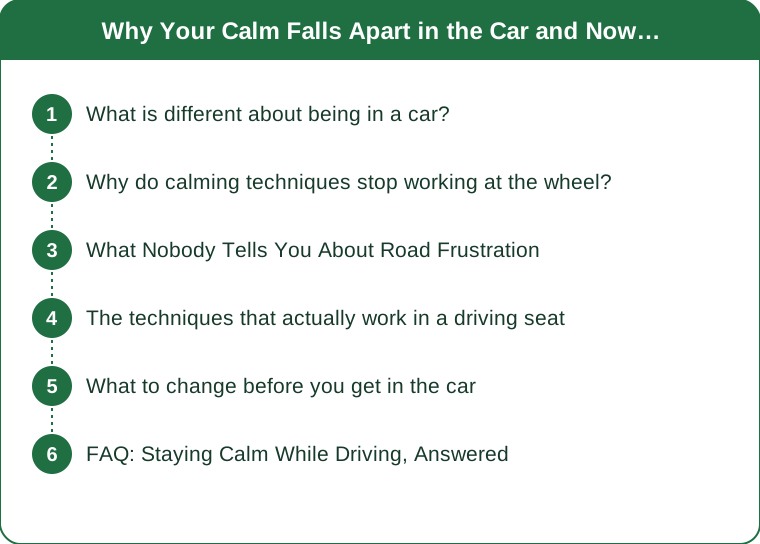
What is different about being in a car?
Four things, and they compound rather than add.
You are immobilised while activated. Frustration produces a physiological readiness to act - adrenaline, muscle tension, elevated heart rate. In most situations you can discharge some of that by moving. In a car you are belted into a seat with your hands on a wheel, so the activation has nowhere to go and it accumulates. This is why the same delay feels far worse in a car than standing in a queue where you can shift your weight and pace.
You have lost control of the timeline entirely. Traffic is the purest form of an unpredictable, uncontrollable delay. Uncertainty about how long something will take is more stressful than a known long wait - the reason a delayed train with no information feels worse than a train you know is forty minutes late.
Other drivers are anonymous. You cannot see faces, you cannot read intent, and you get no social feedback. A person who cuts across you in a corridor apologises with an expression; a car that does the same gives you nothing. Without those signals, the brain fills the gap with the least generous explanation available, which is that it was deliberate.
The posture restricts your breathing. Seated, belted, leaning slightly forward with arms raised to the wheel, most people breathe shallowly into the upper chest. Upper-chest breathing is both a consequence of stress and a cause of it - it maintains the physiological state that makes everything feel more urgent.
Why do calming techniques stop working at the wheel?
Because most of them were designed for conditions the car does not provide.
Most techniques assume you can close your eyes. You cannot. Anything built around eye closure, visualisation, or inward focus is unavailable and unsafe. This eliminates a large proportion of what people have practised.
Most assume you can move. Body scans, progressive muscle relaxation, and mindful walking all use movement or full-body attention. In a driving seat you have partial access at best.
Most assume a few uninterrupted minutes. A traffic escalation happens over about ninety seconds, and the technique needs to work inside that window while you continue driving safely. Anything requiring five quiet minutes is the wrong tool.
And attention is already committed. Driving occupies a substantial share of your attention legitimately. Techniques that need attentional space are competing with a task you cannot deprioritise.
What this leaves is a narrow category: things you can do with your eyes open, hands on the wheel, in under two minutes, without taking attention from the road. That category is small, and it is almost entirely breathing and small physical resets. Which is good news, because those are the two that work fastest anyway.
What Nobody Tells You About Road Frustration
It is usually about the timeline, not the driving. Notice that the same traffic is fine on a Saturday and unbearable on a weekday morning. The traffic did not change. The consequence of the delay did. Most road frustration is anticipatory anxiety about being late, expressed as irritation at whoever is nearest.
It peaks in the last ten minutes, not the first. People handle the first stretch of a delay reasonably well and then deteriorate sharply as the arrival time becomes unachievable. If you know that, you can front-load the intervention rather than waiting to feel bad.
Hunger and thirst are enormous multipliers. The commute home lands at the end of a day, often several hours after eating, frequently mildly dehydrated. Much of what feels like a temperament problem at six in the evening is a blood sugar and hydration problem. A drink of water in the car is not a small intervention.
The car is where the day catches up with you. It is often the first moment with no task demanding attention, which is exactly when everything you deferred surfaces. The frustration attaches itself to the traffic because the traffic is what is in front of you.
Your own driving gets worse before you notice you are annoyed. Following distance shrinks, lane changes get sharper, and speed creeps up several seconds before the feeling registers consciously. Following distance is a genuinely useful early warning signal - if you notice you are close to the car in front, you are already escalated.
Autumn makes it worse for a mechanical reason. Low sun at commuting hours, wet roads, and earlier darkness all increase the actual cognitive load of driving, which leaves less capacity for everything else. Late September commutes are harder than late July ones and it is not your imagination.

The techniques that actually work in a driving seat
Extend the exhale. This is the whole thing. Breathe in for a count of four and out for a count of six or eight. A longer exhale than inhale engages the parasympathetic response directly, and it works within a few breaths. Your eyes stay open, your hands stay on the wheel, and it is safe. If you take one thing from this article, take this one.
The physiological sigh. Two inhales through the nose - a normal one, then a short second one on top - followed by a long slow exhale through the mouth. Repeat two or three times. It is among the fastest ways to reduce acute arousal and it takes about fifteen seconds.
Unclench, in order. Jaw, then shoulders, then hands. Most people drive with all three gripped and never notice. Run through them deliberately at every red light. The hands are the most useful - a loose grip on the wheel makes an immediate difference to how urgent everything feels.
Move at every stop. Roll your shoulders, turn your head side to side, press your feet into the floor and release. This addresses the immobility problem directly and it is the piece most people leave out. Even ten seconds of movement discharges some of the accumulated activation.
Cool air on your face. Open the window or point a vent at your face. The temperature drop on the face is a fast route to a calmer state, and it is more effective than it has any right to be.
Change the audio. Fast, dense, or news-driven audio raises arousal. Have a specific calmer playlist or podcast that you switch to when you notice the following distance shrinking. Making it a switch rather than a decision means it happens.
Give yourself a generous explanation, out loud. Say why the other driver might have done that - late for something, distracted, did not see you. It does not need to be true. Naming an alternative interrupts the assumption of intent, which is what most of the anger is built on.
What to change before you get in the car
The intervention with the best return happens before the engine starts.
Leave earlier than you need to, deliberately. Ten minutes of buffer removes the timeline pressure that most of this is actually about. This is the single highest-impact change available and it is the one people resist most, because it feels like wasting ten minutes to prevent something that might not happen.
Check the traffic first and accept the number. Knowing you will arrive at a certain time is far easier than discovering it minute by minute. Uncertainty is the expensive part, not the delay.
Send the message before you leave. If you are going to be late, say so at the start rather than arriving with an apology. Most of the pressure comes from the anticipated social cost, and removing it early removes the fuel.
Eat something and drink some water. Particularly for an evening commute. Keep water in the car permanently rather than intending to bring it.
Take ninety seconds in the parked car before you drive. Sit, do six slow breaths with the long exhale, and let the previous thing end. This is a transition, and transitions handled deliberately are far cheaper than transitions absorbed at speed.
And do the same at the other end. Two minutes parked outside the house before going in stops the commute being carried through the front door. It is a small habit with a disproportionate effect on the evening.
A note on when this is more than frustration: if driving triggers genuine panic, if you are avoiding routes or journeys, or if anger in the car has led to anything unsafe, that is worth talking to a professional about rather than managing with breathing exercises. This is general information, not medical advice.
FAQ: Staying Calm While Driving, Answered
Why do I get so angry in the car when I am calm otherwise?
The car combines physical immobility, a timeline you cannot control, other people whose intent you cannot read, and a posture that restricts breathing. That combination is genuinely unusual, and reacting to it is not a personality flaw.
What is the fastest way to calm down in traffic?
Extend your exhale - in for four, out for six or eight - for about six breaths, and unclench your jaw, shoulders, and hands in that order. Both are safe with your eyes open and your hands on the wheel, and both work within a minute.
Why does meditation not help when I am driving?
Most techniques assume closed eyes, free movement, or several uninterrupted minutes. None of those are available. Use breathing and small physical resets instead - they are the subset that fits the constraints.
Does music make road rage worse?
It can. Fast, dense, or emotionally charged audio raises arousal, and news often adds to it. Having a specific calmer playlist you switch to when you notice yourself tightening is more effective than deciding in the moment.
How do I stop taking other drivers personally?
Say an alternative explanation out loud - they are late, distracted, did not see you. It does not have to be true. Anonymity is what lets you assume intent, and naming another possibility interrupts the assumption directly.
Why is the evening commute worse than the morning one?
Accumulated fatigue, several hours since eating, mild dehydration, and the fact that it is often the first quiet moment of the day, so everything you deferred arrives at once. Water and a snack in the car address more of this than people expect.
TL;DR:
- The car immobilises you while your body is primed to act, which is why the same delay feels worse there.
- Most calming techniques assume closed eyes, movement, or five quiet minutes. None are available while driving.
- Extend the exhale - in for four, out for six or eight. It is the highest-value technique that fits the constraints.
- Unclench jaw, shoulders, and hands at every red light, and move for ten seconds at every stop.
- Cool air on the face and a calmer playlist both work faster than they should.
- Most road frustration is timeline anxiety. Ten minutes of buffer removes the fuel.
- Shrinking following distance is your earliest warning signal - it moves before the feeling registers.
If driving causes real panic or has led to anything unsafe, that is worth raising with a professional rather than breathing through.
Keep Reading
This article is for general informational and styling purposes only. Fit, sizing, and product availability may vary.