Why You Rehearse Conversations in Your Head (and How to Stop the Loop)

Quick Answer: You rehearse conversations in your head because your brain is trying to reduce uncertainty about a social situation that feels risky. One or two run-throughs can help you prepare. Repeated loops stop being preparation and become worry, which keeps your body tense without making you any more ready. Write down your 3 main points once, set a time limit, and bring your attention back to something physical each time the loop restarts.
You’re in the shower, and you’re also in a meeting that hasn’t happened yet. You say your line. They say theirs. You come back with something sharp. Then you start again from the top with a slightly better opening.
By the time you’ve rinsed your hair, you’ve had the same argument four times with someone who isn’t in the room.

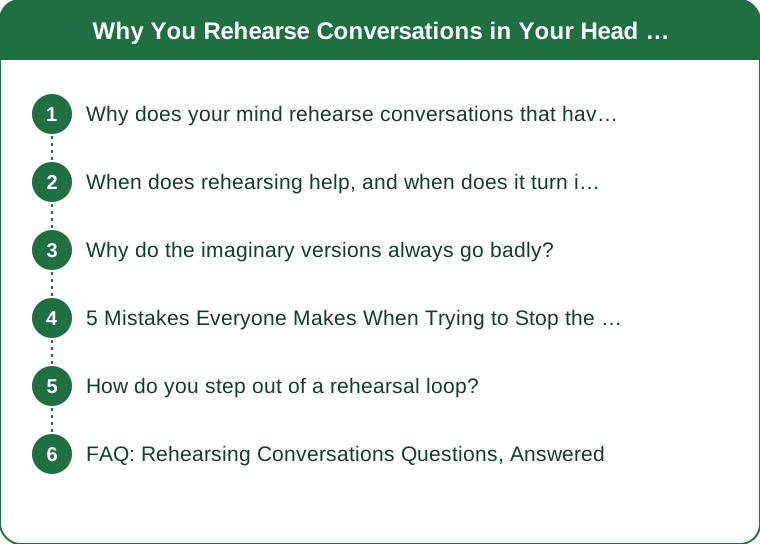
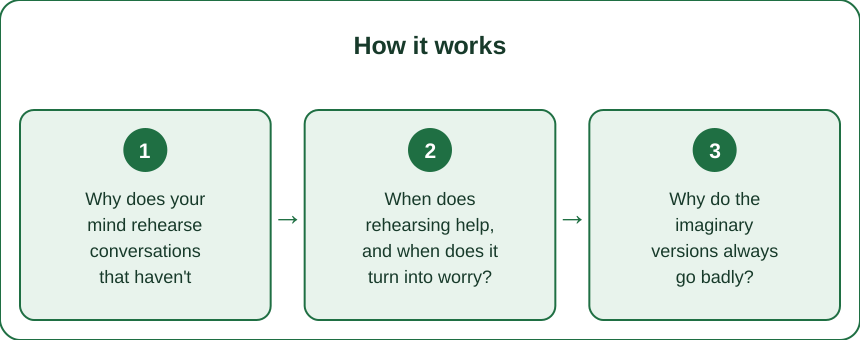
Why does your mind rehearse conversations that haven’t happened?
Your brain is a prediction machine, and other people are the hardest thing it has to predict. Being judged, rejected, or misunderstood registers as a real risk, so your mind tries to prepare.
Mental rehearsal is a normal and useful skill. Athletes use it. So do people before a job interview. A quick run-through helps you find your words.
The trouble starts when the outcome matters a lot and you can’t control it. Your mind keeps simulating, hoping one more version will make you feel certain. It never quite does, because the other person is still unpredictable.
This tends to happen more in people who are conscientious, who dislike conflict, or who’ve been caught off guard in the past. It usually goes along with caring about getting it right.
When does rehearsing help, and when does it turn into worry?
Here’s a simple way to tell them apart.
Helpful rehearsal:
- Happens once or twice
- Ends with a clear idea of what you’ll say
- Leaves you a bit calmer
- Focuses on your own words
Worry in disguise:
- Repeats many times with small changes
- Keeps inventing harsher replies from the other person
- Leaves your jaw tight and your heart rate up
- Shows up at times you can’t act on it, like 2am
A rough guide: if you’ve run it more than 3 times and nothing new has come out of it, the planning is finished and the loop is running on anxiety.
Your body can’t tell the difference between an imagined argument and a real one very well. Each replay can bring a small stress response, which is why rehearsing a hard talk for an hour can leave you as drained as having it.
Why do the imaginary versions always go badly?
Because your mind is scanning for threat, and it writes the script to match.
Anxious thinking leans toward the worst reasonable outcome. So the version of your manager in your head is curt and unimpressed. The version of your friend takes offence. You’re arguing with a character your worry has written.
Real conversations are usually milder. The other person is distracted, or kinder than expected, or says something you never predicted, which means the hours of scripted comebacks rarely get used.
It helps to notice this after the fact. Next time a dreaded conversation goes fine, take ten seconds to register that it did. That’s evidence your mind can use the next time.

5 Mistakes Everyone Makes When Trying to Stop the Loop
1. Telling yourself to stop thinking about it. Suppressing a thought tends to make it return more often. Redirecting works better than forbidding.
2. Rehearsing until it feels perfect. Perfect never arrives. There’s always one more possible reply to prepare for.
3. Scripting the other person’s lines. You can only prepare your half. Time spent writing theirs is time spent on fiction.
4. Rehearsing in bed. Your brain learns that bed is where problems get worked on. Keep the planning for daytime and for a chair.
5. Putting off the conversation to prepare more. This is the one that catches people out. Delay feels like caution, but each extra day gives the loop more room. The shorter the wait, the fewer the replays.
How do you step out of a rehearsal loop?
Pick two or three of these and use them every time. They work better as a routine.
- Write it once. Take 5 minutes and write your 3 main points and one opening sentence. When the loop restarts, tell yourself it’s already written down. Having it on paper lets your mind stop holding it.
- Set a rehearsal window. Give yourself 10 minutes at a set time, say 5pm. If it comes up earlier, note it and save it for the window.
- Come back to your body. Press your feet into the floor and name 5 things you can see. Or breathe in for 4 counts and out for 6, for 5 rounds. A longer exhale helps your body settle.
- Say the first line out loud, once. Hearing your own voice say it calmly is more settling than ten silent versions.
- Schedule the real conversation. Send the message asking for a time. A date on the calendar often quietens the loop more than anything else.
- Plan one line for the unknown. Something like: let me think about that and come back to you. It covers every reply you can’t predict.
FAQ: Rehearsing Conversations Questions, Answered
Is rehearsing conversations in your head a sign of anxiety?
It can be, but it’s also something most people do before a talk that matters. It points toward anxiety when it’s frequent, hard to stop, focused on things going wrong, and leaves you tense or losing sleep.
Why do I rehearse arguments that will never happen?
Your mind is practising for a threat it thinks is possible. It often happens after you’ve felt unheard or caught off guard, and it’s a way of trying to feel prepared next time. Noticing it and returning to what you’re doing is usually enough.
When should I get support for this?
Consider talking to a doctor or a licensed therapist if the loops take up a large part of your day, keep you from sleeping, lead you to avoid people or conversations, or come with ongoing low mood or panic. Approaches like cognitive behavioural therapy are well suited to repetitive worry. This is general information, not medical advice.
TL;DR:
- You rehearse conversations in your head because your brain wants certainty about a social risk
- One or two run-throughs are useful, and after about 3 with nothing new, it has become worry
- The imagined other person is harsher than the real one, because anxiety writes their lines
- Write your 3 points once, set a 10 minute window, use a long-exhale breath, and schedule the real talk
You don’t have to win the argument in the shower. Prepare your half, put it on paper, and let the real conversation be what it turns out to be. It’s usually shorter and kinder than the one you’ve been rehearsing.
Keep Reading
This article is for general informational and styling purposes only. Fit, sizing, and product availability may vary.