Why You Feel Calmer in a Cafe Than You Do at Home

Quick Answer: Cafes feel calmer than home for three reasons that have little to do with the coffee. Ambient noise around 60 to 70 decibels is high enough to mask sudden sounds and low enough not to demand attention, which reduces the startle-and-orient cycle a quiet house produces. There are no unfinished tasks in your visual field, so the low-level pull of things you should be doing disappears. And the environment has a clear implicit purpose, which removes the decision of what you should be doing right now. All three can be partly reproduced at home.
It makes no sense on paper. Your house is quiet, familiar, and free. And yet you can settle into a book in a busy cafe within four minutes and not manage it at home in an hour.

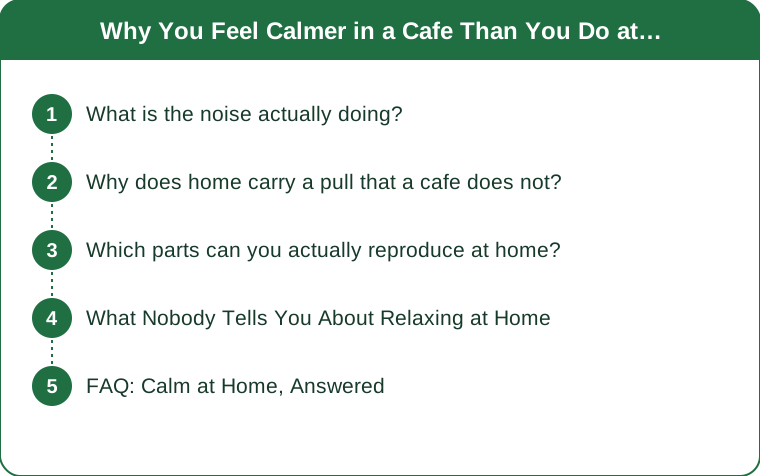
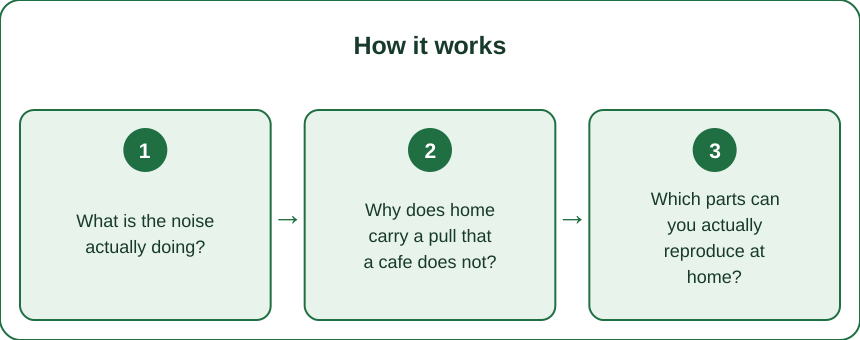
What is the noise actually doing?
Steady ambient noise masks the sudden sounds that trigger an orienting response. In a silent house, the boiler clicking, a car outside, or a neighbour’s door produces a small involuntary attention shift. Each one is trivial. Forty of them across an hour is not.
A cafe runs at a fairly constant level - conversation, machines, movement - which raises the floor high enough that individual sounds do not stand out. Nothing startles you because nothing rises above the background.
The level matters, and there is a fairly narrow band. Around 50 decibels, a house is quiet enough that every event is salient. Around 60 to 70, ambient sound masks events without becoming a demand itself. Above about 75, it becomes the demand.
There is a second effect worth knowing: the sound in a cafe is not directed at you. Speech you are not part of, at a volume where you cannot follow the words, is close to ideal - present enough to mask, meaningless enough to ignore. This is why a cafe recording works better for many people than instrumental music, which has structure your brain tries to follow.
Why does home carry a pull that a cafe does not?
Because everything in your house is a cue for an unfinished task, and cues operate below the level of conscious attention. The laundry basket in your peripheral vision does not need to be noticed to have an effect. The stack of post on the table, the shelf you meant to fix, the plant that needs watering - each one is a small open loop.
A cafe contains nothing you are responsible for. There is no version of a cafe table that generates a to-do item. That absence is the actual product, more than the coffee.
This explains a common and confusing experience: you can relax on holiday within a day, in a room that is objectively less comfortable than your bedroom. The room is not better. It is just not carrying eighty open loops.
It also explains why tidying before you sit down works even when you know it is a delaying tactic. It genuinely reduces the cue load. The problem is that tidying is unbounded, so the sitting-down never happens.
The practical version is not to tidy the house. It is to create one small zone with a controlled visual field - which is a much smaller job.

Which parts can you actually reproduce at home?
Three interventions, in order of effect size for most people.
Raise the noise floor. Not music with structure - something steady. A fan, a cafe recording, brown noise, a window open onto traffic. Aim for a level where you can still hear yourself think but a door closing upstairs no longer registers. Most people underestimate how loud this needs to be.
Build one zone with a clean visual field. One chair, facing a wall or a window rather than into the room. Nothing in the line of sight that is a task. This does not require tidying the house - it requires choosing a direction to face. Turning a chair around is often the entire intervention.
Give the zone a single purpose. The chair is for reading, or for coffee, or for the ten minutes before you start work. Not for laptop admin. A space with one purpose removes the decision about what to do in it, which is the third thing cafes provide for free.
Add a low-cost entry ritual if you want the effect faster. Making a drink, putting a specific playlist on, opening the same notebook. In a cafe, ordering does this work - it is a two-minute transition that signals a change of mode. At home there is usually no transition at all, so you arrive in the chair with the previous activity still running.
What Nobody Tells You About Relaxing at Home
Nobody tells you that the sofa is often the worst seat in the house for actually settling. It faces the room, it faces the television, and it is where the household converges. A less comfortable chair facing a window frequently outperforms it, because comfort was never the limiting factor.
Nobody tells you that the effect degrades when you work in the same spot. If your reading chair is also where you answer emails, the chair acquires the cue properties of work. Cafes stay effective partly because you go to a different one, or at least sit at a different table.
Nobody tells you that being observably present around other people has a genuine calming effect for many. Being alone but among people is a specific condition, and it is unavailable at home by definition. If that turns out to be the active ingredient for you, no amount of environmental tweaking will substitute for occasionally going somewhere.
Nobody tells you that the season changes this substantially. As the evenings get darker, the house gets used more and its cue load goes up. September through February is exactly when the cafe effect gets most noticeable, which is why this is the time of year people conclude they cannot relax at home - it is a seasonal shift in the environment, not a change in you.
FAQ: Calm at Home, Answered
Is background noise not just a distraction?
For demanding creative work, sometimes. For settling and for routine focus, a moderate steady noise floor reliably outperforms silence for most people, because it removes the intermittent sounds that break attention.
How long should I give this before deciding it does not work?
A week. Set up the zone, use it at the same time each day, and change nothing else. If a week of consistent use produces no difference, the active factor for you is probably the presence of other people rather than the environment.
Should I just go to the cafe then?
If it works and it is available, yes - and there is no need to feel that it should not be necessary. The useful thing is knowing which ingredient you are buying, because on the days you cannot go, you can reproduce some of it.
TL;DR:
- Cafes mask sudden sounds with a steady 60 to 70 decibel floor, so your attention stops being pulled by every small noise.
- Nothing in a cafe is an unfinished task of yours - your house is full of low-level cues operating below conscious attention.
- Reproduce it with three things: a raised noise floor, one chair with a clean visual field, and a single purpose for that spot.
- Add a two-minute entry ritual to replace the transition that ordering provides.
- Expect the effect to be strongest from September onward, when the house gets used more and its cue load rises.
You are not failing to relax in your own home. You are trying to relax inside a room that is also your to-do list, with no background noise to hide behind.
Keep Reading
This article is for general informational and styling purposes only. Fit, sizing, and product availability may vary.