Why You Cannot Settle Until the House Is Tidy

Quick Answer: Visible clutter functions as a set of unfinished tasks in your visual field, and unfinished tasks are cognitively sticky — they keep partially occupying attention until they are resolved or externalised. That is why a messy room genuinely interferes with rest rather than merely being unappealing. The useful fix is not to tidy everything; it is to either resolve one zone properly or externalise the tasks onto a list, both of which release the loop.
You sit down. Within ninety seconds you have noticed the pile on the table, the thing on the stairs, and the drying rack.
And you cannot settle until you have dealt with at least one of them, which then takes forty minutes and you never sit down at all.

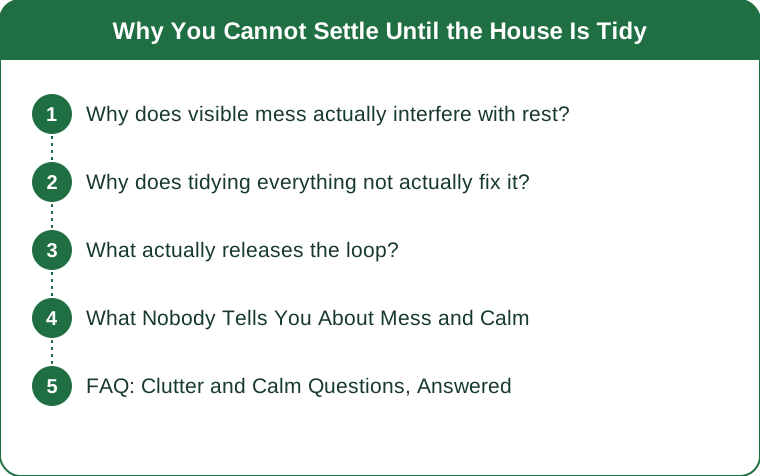
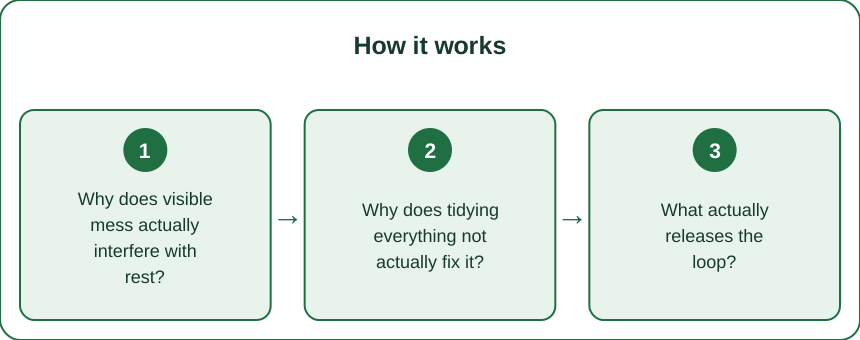
Why does visible mess actually interfere with rest?
Because each item is functioning as a cue for an incomplete task, and incomplete tasks occupy attention in a way completed ones do not.
The useful concept here is that unfinished tasks tend to remain more cognitively accessible than finished ones — they stay partially active, intruding into awareness. In an ordinary environment those tasks live in your head, where you can at least ignore them. In a cluttered room they are in your visual field, being re-triggered every time you look up.
That is the difference between mess being ugly and mess being tiring. A pile of laundry is not just visually unappealing; it is a repeated, involuntary reminder of a task, delivered several times a minute.
Two things make it worse:
Ambiguity. A pile of unsorted things is worse than an equivalent volume of sorted things, because you cannot tell at a glance what the task is. Ambiguous tasks are more cognitively demanding than clear ones, and a pile whose contents you do not know is maximally ambiguous.
Ownership. Mess you are responsible for triggers this far more strongly than mess you are not. This is why other people’s houses are restful regardless of their state, and why the effect is so uneven within a household — the person who holds responsibility for the domestic load experiences a room very differently from someone who does not.
There is genuine research linking cluttered home environments with elevated stress markers, particularly among women managing household responsibilities. The feeling is not a character flaw or excessive fussiness.
Why does tidying everything not actually fix it?
Because the underlying loop is about task completion, not about surfaces, and a house never reaches completion.
If you tidy in order to be able to rest, you have made rest conditional on a state that is inherently temporary and never fully achieved. There is always another zone. The kitchen is done and now you can see the hallway.
This produces a specific and very common pattern: tidying expands to fill the time you had allocated to resting, and then you go to bed having not rested, with a tidy house, feeling vaguely cheated.
There is a second problem. Tidying while depleted is not neutral — it is more work, and it uses the same resource you were trying to restore. Two hours of low-grade domestic labour in the evening is not rest, however satisfying the outcome looks.
And a third: the standard drifts upward. If tidying is the precondition for relaxing, tidiness becomes load-bearing, and the level required creeps higher over time. People who tidy in order to relax generally end up needing a tidier house to relax in than they did a year ago.
The reframe that helps: the goal is not a tidy house. The goal is to stop the visual field from generating task cues, which is a much smaller and more achievable target.

What actually releases the loop?
Two things work, and they work for different reasons. Either is enough.
Option 1: Resolve one zone completely.
Not the house. One zone, defined narrowly — the coffee table, the sofa, and the floor you can see from where you sit. Ten minutes, timer on, and everything that does not belong goes into a single basket which is put somewhere out of sight.
Why it works: it eliminates the visual cues in the space you are actually going to be in, which is the only space generating them while you sit there. The rest of the house is not in your visual field and is therefore not doing this.
The basket is doing real work. It converts twenty individual ambiguous tasks into one deferred, defined task. That is a substantial reduction in cognitive load and it takes ninety seconds.
Option 2: Externalise rather than resolve.
Write the tasks down. Three minutes, a piece of paper, everything you can see that is bothering you.
Why it works: the loop is partly maintained by a concern that you will forget. Writing something down reliably reduces its intrusiveness — this is the well-documented mechanism behind writing a to-do list before bed helping people fall asleep faster.
Which to use: the zone reset works better when you are going to be in the room for a while. The list works better when you are too tired to tidy, which is most evenings. Doing either one is dramatically better than doing neither, and trying to do both is how you end up tidying for an hour again.
What Nobody Tells You About Mess and Calm
The trigger is usually one specific object, not the general state. If you look honestly, there is often a single thing — a pile of post, one chair, the thing that has been on the stairs for a week — doing most of the work. Dealing with that one object frequently releases most of the feeling, and it takes two minutes.
Horizontal surfaces are the main offenders. Clutter on floors and tables registers far more strongly than the same volume inside cupboards or on shelves. Clearing surfaces produces a disproportionate sense of calm relative to the effort involved.
It is worse in the evening and worse in autumn. Depleted attention makes intrusive cues harder to ignore, and you are more depleted in the evening. And in autumn everyone is indoors more, with the lights on, looking at their rooms for considerably more hours than in July.
The uneven-distribution problem is real. If one person in a household experiences the mess as a stack of pending obligations and another does not, they are genuinely in different rooms. That asymmetry is usually about who holds responsibility for the domestic mental load, not about who is tidier, and it is worth naming as such rather than as a difference in standards.
A tidy house does not produce calm on its own. Plenty of people have very tidy houses and no calm at all, because the loop simply attaches to something else. If tidying has become compulsory rather than useful — if you cannot leave things, if it produces real distress, or if it is taking up a lot of your time — that is worth talking to a professional about. This is general information, not medical advice.
FAQ: Clutter and Calm Questions, Answered
Is it actually anxiety, or am I just tidy?
The distinction that matters is whether it is intrusive. Preferring a tidy house is a preference. Being unable to rest, repeatedly pulled back to the same thoughts, and finding the mess genuinely distressing is something else. Neither is a problem in itself; the second one is worth having a strategy for.
Does decluttering permanently fix it?
Owning fewer things does reduce how much can accumulate, and many people find it genuinely helps. It does not change the underlying mechanism — with fewer possessions, a smaller amount of mess often triggers the same response. Useful, not curative.
What about when it is someone else’s mess?
Harder, because you cannot resolve it unilaterally and the resentment adds to the load. The zone approach still works for the space you occupy. Beyond that, this is a conversation about distribution of domestic responsibility rather than a tidying problem, and treating it as a tidying problem is why it never resolves.
Why can I relax in a messy hotel room but not at home?
Because there are no tasks attached. The mess is not yours, nothing in the room is a pending obligation, and nobody expects you to deal with it. This is strong evidence that the mechanism is about task cues rather than about visual disorder — and it is also why a night away feels so disproportionately restorative.
TL;DR:
- Visible clutter acts as repeated cues for unfinished tasks, which stay cognitively active in a way finished ones do not.
- Ambiguous piles are worse than clear ones, and mess you are responsible for triggers this far more than mess you are not.
- Tidying the whole house does not fix it — it makes rest conditional on a state that never arrives, and it uses the resource you were restoring.
- Reset one zone in ten minutes with a basket, or write the tasks down in three minutes. Either releases the loop.
- One specific object is usually doing most of the work. Deal with that.
- Clearing horizontal surfaces gives the largest return for the effort.
The goal is not a tidy house. It is a visual field that stops generating tasks. This is general information, not medical advice.
Keep Reading
This article is for general informational and styling purposes only. Fit, sizing, and product availability may vary.