Why Waiting for a Reply Makes You More Anxious Than Actual Bad News

Quick Answer: Waiting feels worse than bad news because your brain treats an unknown outcome as a threat it can’t prepare for, so it stays on alert the whole time. Bad news gives it something to act on. You can calm the wait by setting specific times to check, giving your body a physical reset, and deciding in advance what you’ll do in each outcome.
You sent the message at 9:14. It’s 9:40 now. You’ve picked up your phone eleven times, reread what you wrote four times, and built three separate stories about what the silence means.
If the answer had simply been no, you’d be sad and already moving on. Your brain is built in a way that makes this stretch harder.

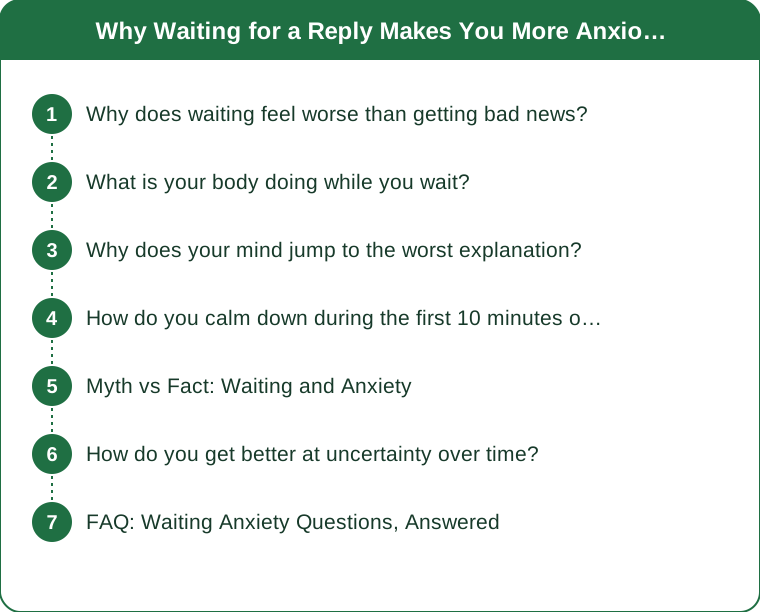
Why does waiting feel worse than getting bad news?
Your brain is a prediction machine. Its main job is to guess what happens next so your body can get ready. A known outcome, even a bad one, lets it settle on a plan. An unknown one doesn’t.
With no answer available, your threat system keeps scanning. It can’t stand down, because the thing it’s watching for hasn’t been ruled out. Research on uncertainty has found that people often show more stress when a bad outcome is possible but unsure than when it’s certain.
Psychologists call the trait behind this intolerance of uncertainty. Everyone has some. If you run higher on it, ‘I don’t know yet’ gets handled like ‘something is wrong’.
What is your body doing while you wait?
It’s holding a low-level alarm state. Stress hormones stay slightly raised. Your breathing gets shallower and moves up into your chest. Your shoulders and jaw tighten. Your stomach may feel fluttery or tight.
Your attention narrows too. That’s why you can’t focus on the spreadsheet in front of you but can recall the exact wording of your own text.
Then the phone adds a loop. Each check is a tiny gamble: maybe the reply is there. Rewards that arrive unpredictably are the most habit-forming kind, so every empty check makes the next one more likely. Ten checks in twenty minutes doesn’t mean you lack discipline. The setup produces that.
Why does your mind jump to the worst explanation?
A blank gets filled. When there’s no information, your brain supplies some, and it leans negative because missing a threat used to cost more than raising a false alarm.
So silence becomes ‘they’re upset’, ‘I didn’t get it’, or ‘the results are bad’. The more the outcome matters to you, the darker the fill-in.
Notice how rarely the invented story includes boring explanations. The other person’s phone is on silent. They read it while cooking dinner and meant to answer. The office that’s calling you back is running 2 hours behind. Boring explanations are usually the true ones, and they’re the last ones your mind offers.

How do you calm down during the first 10 minutes of waiting?
Work on your body first, then on the checking.
- Slow your exhale. Breathe in through your nose for 4 counts and out for 6 to 8. Do 6 rounds. It takes about 90 seconds and tells your nervous system the emergency isn’t immediate.
- Change rooms or go outside for 5 minutes. Movement burns off some of the alert energy.
- Put the phone somewhere that takes effort to reach. Another room, a zipped bag, a high shelf. Out of arm’s reach matters more than willpower.
- Set check times. Pick specific ones, such as on the hour, and check only then. Between those times, the question is closed.
- Write a two-line plan. ‘If it’s yes, I’ll do this. If it’s no, I’ll do this.’ Now your brain has a plan for both outcomes, which is what it wanted from the start.
- Do one absorbing 20-minute task. Fold laundry, cook something, walk a fixed loop. Hands busy, eyes away from a screen.
Myth vs Fact: Waiting and Anxiety
Myth: Checking more often helps you feel in control. Fact: each check gives a second of relief and then resets the tension. Fewer, scheduled checks lower anxiety more.
Myth: Expecting the worst protects you. Fact: bracing doesn’t soften bad news much when it comes. It just means you feel bad during the wait as well. And if the news is fine, you suffered for nothing.
Myth: You should distract yourself completely. Fact: forcing the thought away tends to make it bounce back. A scheduled check gives the worry a place to go, which works better than pretending it isn’t there.
Myth: Calm people don’t mind waiting. Fact: nearly everyone finds it uncomfortable. People who look calm have usually built a routine for it. That’s the part you can copy, and it surprises people how mechanical it is.
How do you get better at uncertainty over time?
Tolerance for not knowing can be trained, the way a muscle can. Small, deliberate doses work best.
- Delay one check a day by 10 minutes. When you feel the pull to look something up or refresh, wait. Next week, make it 15.
- Leave one small thing unresolved on purpose. Don’t read the reviews before trying the restaurant. Send the email without rereading it a third time.
- Label it. Say to yourself, ‘This is the not-knowing feeling.’ Naming a state lowers its intensity a little and separates the feeling from the story.
- Keep a short record. For 2 weeks, jot down what you feared during a wait and what actually happened. Most people find the boring explanation wins far more often than they expected.
If waiting or uncertainty regularly keeps you from sleeping, working, or eating, or the worry feels constant across many areas of life, talk with a therapist or your doctor. Approaches such as cognitive behavioral therapy target this pattern directly. This is general information, not medical advice.
FAQ: Waiting Anxiety Questions, Answered
Why do I get so anxious waiting for a text back?
A text has no tone of voice and no guaranteed reply time, so there’s a lot of blank space for your mind to fill. If the relationship matters to you, the fill-in skews negative. Scheduled check times and a physical reset help more than rereading the message.
How do I stop checking my phone when I’m waiting on something?
Make checking inconvenient and planned. Put the phone in another room, turn on sound for that one contact only, and pick set times to look. The urge usually peaks and fades within a few minutes if you don’t act on it.
Is anxiety about waiting a sign of an anxiety disorder?
Not by itself. Disliking uncertainty is very common. It’s worth a professional conversation if the worry is hard to control on most days, has lasted for months, and gets in the way of sleep, work, or relationships.
TL;DR:
- Your brain can prepare for bad news but can’t prepare for no news, so it stays on alert while you wait
- Phone checking is an unpredictable-reward loop, and every empty check strengthens the urge
- In the first 10 minutes: lengthen your exhale, move, put the phone out of reach, set check times, and write a two-line plan for each outcome
- Build tolerance with small daily doses of deliberate not-knowing
The reply will come when it comes, and checking won’t speed it up. What you can change is how the next hour feels. Put the phone in the other room, breathe out slowly, and give your hands something to do until the top of the hour.
Keep Reading
This article is for general informational and styling purposes only. Fit, sizing, and product availability may vary.