Why the Same Worry Feels Solvable at 10am and Impossible at 10pm

Quick Answer: Evening worry feels worse because the cognitive resources that generate perspective are depleted, cortisol is at its daily low, and the environment offers no distraction or corrective input. The content of the worry is identical; the machinery evaluating it is running on much less.
At ten in the morning it is a task with three steps. At ten at night it is proof that everything is falling apart. Same problem, same facts, same person.

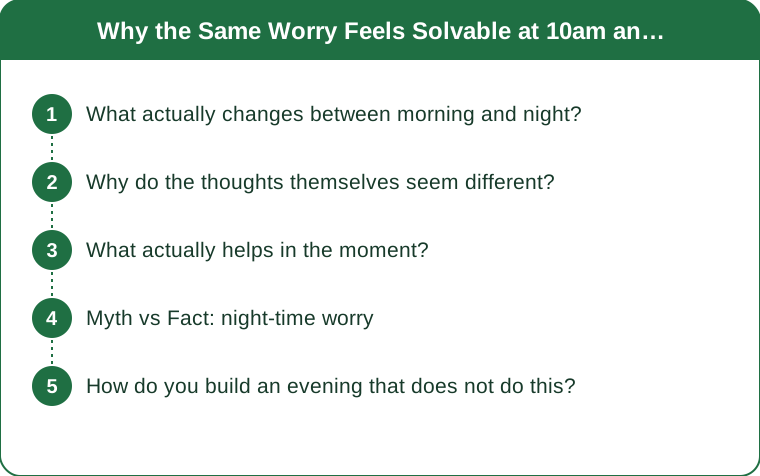
What actually changes between morning and night?
Three separate systems, and they all move the same direction.
Cognitive resources deplete. Perspective-taking, weighing evidence, and generating alternative interpretations are effortful, and effortful thinking gets harder across a day of decisions. By late evening you are running your worry through a system with far less capacity to contextualise it.
Cortisol is at its daily minimum. It peaks about 30 minutes after waking and falls through the day. That morning peak is part of why problems feel actionable early — you have a physiological readiness that is simply gone at 10pm.
Input stops. During the day, worries are constantly corrected by reality — an email answers a question, a colleague reacts normally, something else demands attention. At night nothing corrects anything. The worry runs uncontested, and an uncontested worry expands to fill the space available.
Add the fourth thing that is not physiological at all: you cannot act at 10pm. The office is closed, the person is asleep, nothing can be resolved. A problem you cannot move on is experienced very differently from one you can, even if it is the same problem.
Why do the thoughts themselves seem different?
Because fatigue does not just reduce capacity, it changes the type of thinking that is easiest.
Tired cognition drifts toward the categorical and away from the specific. A daytime thought is I need to send that email; the same thought at night becomes I am bad at my job. That shift from concrete to global is one of the most reliable features of evening worry, and it is what makes it feel so much heavier.
It also drifts toward the future. Daytime worry tends to be about the next action; night worry expands to consequences three steps out, which are by definition unresolvable and therefore endless.
Recognising the shift is a genuinely useful intervention in itself. Not as a trick to dismiss the feeling, but as information: if the thought has gone global and future-tense, you are looking at a fatigue signature, not a new insight. The thing that feels like sudden clarity at 11pm — finally seeing how bad it really is — is the least reliable thinking of your day, reliably.
This is not the same as saying the worry is not real. Real problems exist at 10pm. It is that your assessment of their size and solvability is measurably distorted at that hour, and you can know that in advance.

What actually helps in the moment?
Three things, in order of how quickly they work.
Write the concrete version. Not a journal entry — one line, in the form of the next physical action. Email Sarah about the timeline. Check the bank balance Tuesday. The act of forcing the global thought back into a specific action does most of the work, and it takes about ninety seconds.
Change your physical state before your mental one. Stand up, get water, go to a different room. Worry that has been running while you lie still becomes noticeably less absorbing once you move, because part of what sustained it was that nothing else was competing for attention.
Use a longer exhale, lying down. Four in through the nose, six or seven out, unforced, for two minutes. Evening is when reclined breathing works better than standing, because you want to downshift rather than compose.
What does not help: trying to solve it. Trying to stop thinking about it. Reaching for the phone, which reliably supplies either more input to worry about or a blue-lit hour you did not intend.
If a worry survives all three, write it down and give it a time tomorrow. Not vaguely — a slot. Worry that has an appointment is far easier to set down than worry you are trying to dismiss.
Myth vs Fact: night-time worry
Myth: If it feels this bad at night, it must be serious. Fact: Intensity at 10pm correlates far more with your fatigue than with the size of the problem. The reliable test is how it reads at 10am, and almost everyone finds the morning version smaller.
Myth: You should sort it out before you sleep. Fact: Trying to solve a problem with your least capable thinking is how one worry becomes two hours. Capturing it and scheduling it consistently outperforms resolving it.
Myth: Evening anxiety means you need to fix your sleep. Fact: Often it is the reverse — the worry is disrupting sleep rather than poor sleep causing the worry. Both are worth addressing, but the order matters for what you try first.
Myth: This is worse in winter, so nothing can be done until spring. Fact: It does get worse as evenings darken and lengthen, which in the northern US is already noticeable by mid-September. But the mechanism — earlier darkness, less evening activity, more unstructured time indoors — is exactly what an evening routine addresses. Seasonal does not mean fixed.
Myth: Being tired is the whole explanation. Fact: Fatigue is the biggest single factor and not the only one. If evening worry is persistent, escalating, or accompanied by panic symptoms or difficulty functioning, that deserves proper support rather than a routine. This is general information, not medical advice.
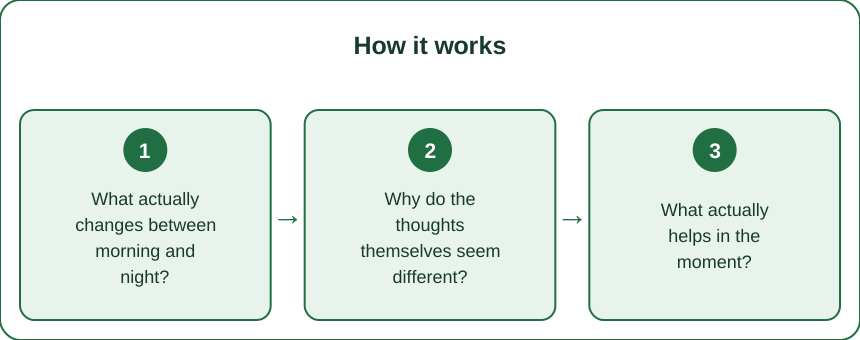
How do you build an evening that does not do this?
The goal is not to eliminate evening worry. It is to reduce the window in which it runs uncontested.
Give the day a closing point. A ten-minute review — what happened, what is tomorrow’s first action, what can be genuinely put down — done at a consistent time, ideally not in the bedroom. This is the single highest-return habit for this specific problem, and it works because it moves worry to a time when you can still think.
Keep some evening structure as the light goes. As September progresses, the hours between dinner and bed get darker and emptier, and unstructured time is where worry expands. A walk, a call, a task with a defined end — anything that occupies the window.
Move the phone out of the last thirty minutes. Not for the blue light, primarily, but because it supplies an endless stream of new material at exactly the hour when your filtering is worst.
Notice which nights are bad. Most people find a pattern — Sunday, or nights after a specific kind of day. A pattern is far easier to plan around than a mood is, and it usually only takes two weeks of noting it to see one.
Should I get up if I cannot stop worrying in bed?
Yes, if it has been more than about twenty minutes. Go to another room, low light, do something undemanding, and return when you feel sleepy. Lying in bed worrying teaches your brain that bed is where worrying happens.
Does the morning-versus-night gap ever close?
It narrows with better sleep, a closing routine, and treatment where anxiety is clinical, but some gap is normal and permanent — the physiology is real. The goal is to expect it rather than eliminate it.
Is writing worries down enough on its own?
For many people, surprisingly, close to it — as long as what you write is the next concrete action rather than the feeling. The specificity is what does the work.
TL;DR:
- Evening worry feels worse because cognitive resources are depleted, cortisol is at its low, nothing corrects the thought, and you cannot act on it.
- Fatigue shifts thinking from concrete to global and future-tense — if the thought has gone global, that is a fatigue signature, not new insight.
- In the moment: write the next concrete action, change your physical position, use a long unforced exhale lying down.
- Longer term: a ten-minute closing review earlier in the evening, some structure in the darkening hours, and the phone out of the last half hour.
The reason this matters beyond one bad night is that decisions made at 11pm tend to stick — people quit things, send things, and conclude things at exactly the hour their judgment is least reliable. Try the closing review for two weeks and notice how the 10am version of the same worry compares.
Keep Reading
This article is for general informational and styling purposes only. Fit, sizing, and product availability may vary.