Why Sunday Evening Anxiety Starts Earlier in Late August

Quick Answer: Late-August Sunday dread arrives earlier because three things shift at once - daylight is fading roughly 2-3 minutes per day, so evening cues come sooner; the calendar fills with genuine transitions like school and fiscal quarters; and anticipatory anxiety attaches itself to the earliest available cue. The fix is not to argue with the feeling but to move the cue: give Sunday afternoon a definite ending and a definite next thing.
In June, Sunday evening felt fine until quite late. Now the same tightening arrives around four in the afternoon while the day is objectively still going. Nothing on your calendar changed that much. The container the day sits in did.

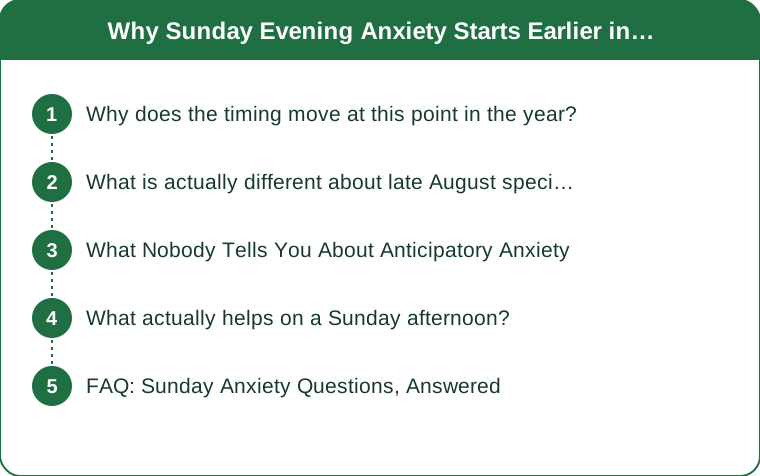
Why does the timing move at this point in the year?
Because your sense of when the day is ending is mostly a light signal, and the light is moving fast.
In the second half of August in most of the northern US, sunset is retreating by about 2-3 minutes per day. That compounds to nearly half an hour over two weeks and well over an hour compared to the solstice. The angle changes too - late-afternoon light gets longer and more golden earlier, and that specific quality of light is one of the strongest end-of-day cues your brain has.
So at 4pm you are getting a lighting environment that in June belonged to 6pm. If your dread is cued to the feeling of the day winding down rather than to the clock, it arrives with the light.
On top of that, melatonin onset begins to shift earlier as evening light dims sooner, which nudges alertness down in the late afternoon. A drop in alertness makes rumination easier - it is much harder to interrupt an anxious thought loop when you are already flat.
What is actually different about late August specifically?
This is the one point in the year when several separate calendars restart at the same time.
School calendars dominate the emotional landscape whether or not you have children, because they set the rhythm of traffic, workplaces, and social availability. Work calendars ramp - Q3 ends soon, budgets and planning cycles wake back up, and the colleagues who were away are returning. Social calendars contract as summer plans expire.
The result is a genuine cluster of transitions rather than an imagined one. Anticipatory anxiety is not irrational here; it is your brain correctly detecting that a lot of things are about to change state, and doing what it does with uncertainty - running simulations early and often.
There is also an unfinished-summer effect that is easy to underestimate. Many people carry a quiet list of things summer was supposed to include, and late August is when that list becomes a deadline. Grief for a season is small, but it is real, and it makes ordinary Sunday dread heavier than it would be in February.

What Nobody Tells You About Anticipatory Anxiety
It is not primarily about the thing you are dreading. It is about the open loop.
Anticipatory anxiety is your brain’s attempt to prepare for an unspecified demand. Because the demand is unspecified, no amount of thinking closes the loop - which is why an hour of Sunday afternoon worrying leaves you more tired and no more prepared. The loop stays open precisely because nothing you do in your head can satisfy it.
Three things follow from that, and none of them are obvious.
First, specificity reduces it more than reassurance does. Telling yourself it will be fine does very little. Writing down the actual first three tasks of Monday morning does a lot, because it converts an open-ended threat into a finite list.
Second, the anxiety attaches to the earliest available cue and creeps backward over time. If Sunday evening becomes reliably unpleasant, your brain learns to flag Sunday afternoon as the warning zone, then Sunday lunch. This is ordinary associative learning and it is why the timing drifts earlier year over year, not just seasonally.
Third, the most effective interventions are structural rather than emotional. A defined end to the weekend beats any amount of trying to feel calm. The feeling follows the structure much more reliably than the structure follows the feeling.
What actually helps on a Sunday afternoon?
Give the day an ending and a next thing. In that order.
Close the loop in writing, once. Spend ten minutes writing tomorrow’s first three concrete actions - not goals, actions, at the level of open the file, send the message, leave at 7:40. Then close the notebook. This is the single highest-value intervention and it works because it satisfies the preparation drive with something finite.
Schedule a real Sunday-evening event. Not rest - an actual thing with a start time. A walk at 6, a call with someone at 7, a specific show at 8. Dread expands into unstructured time and contracts when the time is already claimed.
Move your body at the transition point. A twenty-minute walk in the late-afternoon light does two useful things at once: it interrupts the rumination loop, and it delivers evening light exposure that helps stabilize the circadian shift you are currently fighting.
Protect the light. As natural light drops earlier, keep your indoor environment brighter until you genuinely want to wind down, then dim it deliberately. Letting your room dim at the same rate as the sky pulls your whole evening earlier and lengthens the anxious window.
Stop treating Sunday as a repair day. Sundays spent catching up on everything you did not do all week guarantee that Sunday afternoon becomes an audit of your failures. Move errands to Saturday if you possibly can.
FAQ: Sunday Anxiety Questions, Answered
Is this seasonal affective disorder starting early?
Usually not. Seasonal patterns of low mood typically develop over weeks of sustained reduced light, most commonly from late autumn onward, and they involve persistent changes in mood, sleep, and appetite. Late-August Sunday dread is generally an anticipatory-anxiety pattern tied to specific transitions. If low mood is persisting through the week and affecting sleep, appetite, or function, that is worth discussing with a professional - this is general information, not medical advice.
Does it help to work a bit on Sunday to get ahead?
Rarely, and it usually backfires. A short, bounded planning session - the ten-minute list above - reduces anxiety. Actually working extends the workweek into the one part of the calendar that was supposed to be protected, and it teaches your brain that Sunday is a work day, which makes next Sunday worse.
Why do I feel it even though I like my job?
Because anticipatory anxiety responds to transition and uncertainty, not to whether you enjoy the destination. Liking your work does not remove the discontinuity between a self-directed weekend and a demand-driven week. People with jobs they love report Sunday dread at surprisingly high rates for exactly this reason.
TL;DR:
- Sunday dread moves earlier in late August because sunset retreats 2-3 minutes per day and the end-of-day light cue arrives sooner.
- Real calendar transitions cluster now - school, quarter-end, contracting social plans - so the anxiety is detecting something genuine.
- Anticipatory anxiety is an open loop; specific written next actions close it better than reassurance.
- Structure beats sentiment: a scheduled Sunday-evening event, a late-afternoon walk, and no Sunday catch-up work.
The feeling arriving at four instead of eight is not evidence that things are getting worse. It is a light cue and a calendar doing exactly what they do this time of year. Give the afternoon a definite ending, put one real thing in the evening, and the window shrinks back to something you can sit through with a cup of tea.
Keep Reading
This article is for general informational and styling purposes only. Fit, sizing, and product availability may vary.