Why Rest Feels Like Something You Have to Earn, and How to Stop Negotiating With Yourself

Quick Answer: The belief that rest must be earned is a learned rule, not a fact, and it is self-defeating because the qualifying condition, a finished list, never arrives. Scheduling rest before the work rather than after it breaks the loop faster than trying to argue yourself out of the guilt.
You sat down at nine. By nine-fifteen you were up again, because there was a load of washing you could put on, and it felt physically uncomfortable not to.
Notice the shape of the rule: rest is a reward for completion. Now notice that the list has never once been complete.

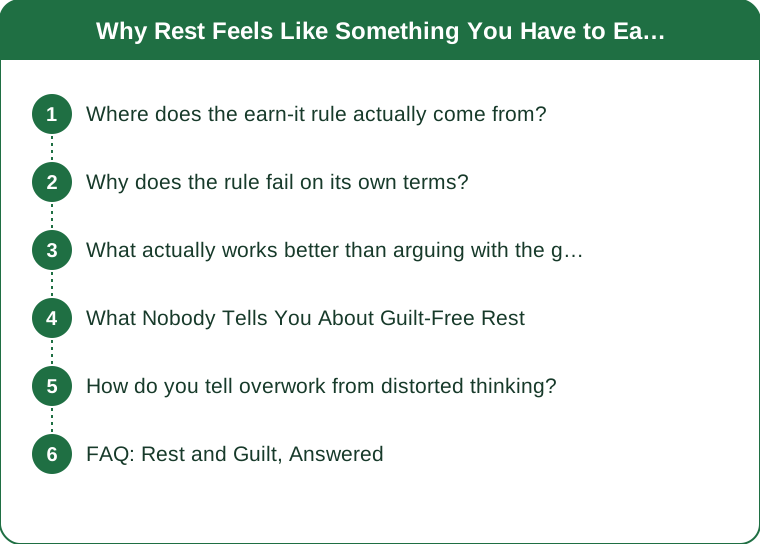
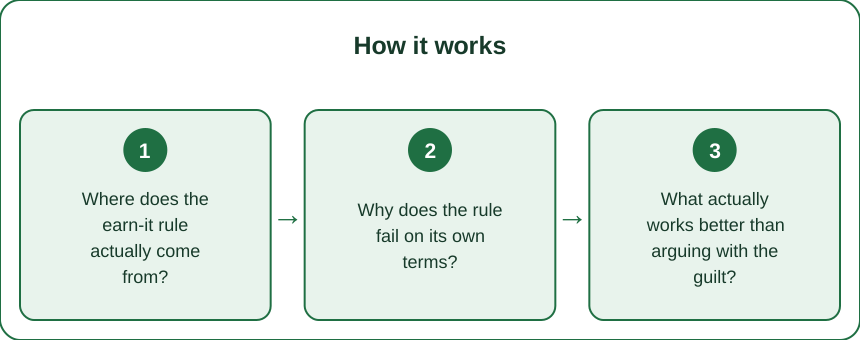
Where does the earn-it rule actually come from?
It is learned, and usually from several directions at once.
Childhood conditioning. Homework before television, chores before play. A perfectly reasonable teaching tool for a nine-year-old, which nobody ever formally revoked. The rule persisted while the context changed entirely, because a child’s homework had an end and adult work does not.
Cultural reinforcement. Busyness is treated as a status marker, and tiredness as evidence of worth. Very few people are ever praised for having rested well.
Identity fusion. If your sense of being a good person is tied to output, then stopping is not neutral, it registers as a threat to who you are. That is why rest can produce genuine anxiety rather than mild guilt.
And an accurate response to real overload. Sometimes the discomfort is not distorted thinking, it is correct information: there genuinely is too much, and no arrangement of mindset will fix a workload problem. Distinguishing these two matters, because the first needs a different rule and the second needs fewer tasks.
Why does the rule fail on its own terms?
Because the condition is unachievable, and everyone quietly knows it.
Adult responsibility is not a finite list. It regenerates. Laundry, email, tidying, admin, care work, all of it refills the moment it empties. A rule that says rest is permitted after completion is functionally a rule that says rest is never permitted.
There is a well-documented tendency to remember unfinished tasks far more vividly than completed ones. Your mind is essentially designed to keep incomplete items loud, and since your list never empties, the volume never drops.
So the practical result is not that you never rest. It is that you rest badly. You sit down while still on duty, half attending, checking your phone, doing something restful with the mental posture of someone about to be interrupted. That produces very little recovery, which increases fatigue, which increases the sense of being behind, which raises the bar for what you would have to complete before you deserve to stop.
The loop tightens itself. And the thing that eventually breaks it is usually illness or burnout, which is a costly way to be given permission.
What actually works better than arguing with the guilt?
Changing the sequence rather than the belief. You are unlikely to talk yourself out of a rule learned over decades, but you can change the order of your evening in a way the rule cannot follow.
Put rest before the last task, not after it. Deliberately leave one small thing undone, sit down for twenty minutes, then do it. This directly tests the prediction that resting-while-incomplete is intolerable. It is uncomfortable for about three evenings and then it is not.
Give rest a defined shape. Vague open-ended relaxation is easily invaded. Twenty minutes with a book, a specific episode, a walk around the block: a container with edges is much harder to negotiate away than an unspecified intention to relax later.
Write the list down, then close it. Externalizing unfinished tasks reliably reduces their intrusiveness, particularly when you note when you will do them. The point is not organization; it is that your mind stops rehearsing them.
Name it as a task if you must. For a lot of people the sentence that works is not I deserve this, which the rule will argue with, but this is scheduled recovery and it is part of the work. Slightly cynical. Highly effective.

What Nobody Tells You About Guilt-Free Rest
It gets worse before it gets better. The first few times you rest without qualifying for it, anxiety often rises rather than falls, because you are sitting with the discomfort instead of discharging it into a task. This is expected and it settles within a week or two. Most people quit on day two and conclude that rest does not work for them.
Phone scrolling is not the rest you are missing. It occupies attention without restoring anything, which is why two hours of it can leave you more depleted. The rest that actually recovers you is usually duller: staring out of a window, a walk with no podcast, lying down, a bath, a book.
The tidy-house rule is very common and worth naming. Many people cannot settle until the visible environment is clear. If that is you, a fifteen-minute reset of only the room you will be sitting in, timer on, satisfies it at a fraction of the cost of a whole-house standard.
Rest is not the same as sleep, and it is not the same as fun. Three different needs, frequently collapsed into one and then all three unmet.
And the uncomfortable one: for some people this is not a mindset issue at all. If you genuinely cannot stop, if stillness produces real distress, or if you are running on empty for months, that is worth discussing with a doctor or therapist rather than optimizing. This is general information, not medical advice.
How do you tell overwork from distorted thinking?
A useful test, because the two need opposite responses.
Run the arithmetic honestly. Write down your actual committed hours in a week: paid work, commuting, caring, household, admin. Then subtract from 168 and take out sleep. If the number left is near zero, you do not have a guilt problem, you have a capacity problem, and the answer is removing or delegating tasks rather than reframing anything.
Check what happens when you do rest. If twenty minutes leaves you noticeably better, the system is working and the guilt is the obstacle. If you rest and feel no different, or worse, for weeks on end, that points toward genuine depletion, or toward something medical such as low iron, thyroid issues, or depression, all of which are worth ruling out.
Ask what you would say to a friend describing your exact week. Almost everyone’s answer to that reveals the double standard immediately, and it is a faster route than introspection.
And notice whether the rule applies to everyone or only to you. If you would never expect your partner or colleague to earn their evening the way you do, the belief is not a principle you hold, it is a rule you apply to yourself alone. That is worth taking seriously.
FAQ: Rest and Guilt, Answered
How long does it take to feel comfortable resting?
Most people notice a real shift in two to four weeks of resting deliberately rather than incidentally, provided they keep going through the first uncomfortable week. The discomfort is the extinction process working, not a sign it is wrong for you. What speeds it up most is making the rest specific and short at first, twenty minutes with a clear start and end, rather than attempting a whole free evening.
Is it normal to feel anxious when I finally stop?
Very. Sustained activity keeps arousal high and stops you noticing what is underneath it, and when you stop, that content arrives. It is why people often feel worst on the first day of a holiday. It usually settles within a day or two, and gentle activity, a walk, cooking, tidying one drawer, is often easier to land in than complete stillness.
What if I genuinely do not have time to rest?
Then the honest answer is that something has to come out of the week, and no framing will substitute. Start by looking for the things being done to a standard nobody requires, and for anything that could be shared, delegated or dropped entirely. If nothing is removable and this has run for months, treat it as a workload and support problem to raise with the people involved, rather than a personal failing to manage privately.
TL;DR:
- The earn-it rule is learned, and it fails because the qualifying condition, a finished list, never arrives.
- Resting while still incomplete is the specific thing to practise, so put rest before the last task rather than after it.
- Give rest edges: a defined twenty minutes beats a vague intention, and phone scrolling is not the rest you are short of.
- Run the hours arithmetic to check whether you have a guilt problem or a genuine capacity problem, because they need opposite fixes.
The goal is not to stop caring about the list. It is to stop treating your own recovery as the one item that requires everything else to be finished first. Try leaving one small thing undone tonight and sitting down anyway; three evenings of that teaches more than any amount of reasoning about it.
Keep Reading
This article is for general informational and styling purposes only. Fit, sizing, and product availability may vary.