Why You Feel More Anxious as the Days Get Shorter
Quick Answer: Anxiety often rises as days get shorter because reduced daylight disrupts your circadian rhythm and lowers serotonin production, both of which directly affect mood regulation. Getting bright light exposure in the first hour after waking is the single most effective counter, more so than evening light.
Somewhere in late September or October, a specific kind of unease shows up — not quite sadness, more like a low hum of alertness that wasn’t there in summer. If you’ve noticed it happens every year around this time, that’s not a coincidence. Your nervous system is responding to something real and measurable: less light.
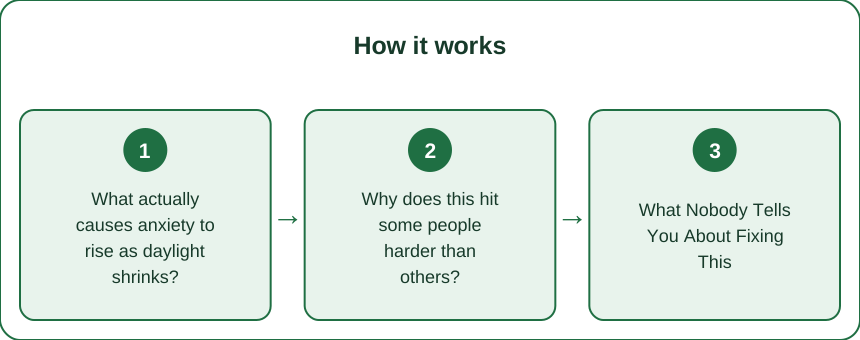
What actually causes anxiety to rise as daylight shrinks?
Two mechanisms, working together. First, less morning light delays your circadian rhythm, which throws off the natural rise and fall of cortisol that’s supposed to happen on a predictable schedule. A dysregulated cortisol rhythm shows up as exactly the kind of low-grade alertness and unease many people describe in fall.
Second, shorter days reduce serotonin production, a neurotransmitter directly tied to mood stability. Lower serotonin doesn’t just cause sadness — it can present as anxiety and irritability just as easily, which is why this seasonal shift gets misread as ‘just stress’ rather than something with a physical driver.
Why does this hit some people harder than others?
Sensitivity to seasonal light changes varies a lot person to person, and it’s not fully understood why. Geographic latitude plays a role — the further from the equator, the sharper the daylight drop in fall. Personal history matters too: people with any anxiety or mood-disorder history tend to be more sensitive to the shift.
If your anxiety noticeably worsens every year starting around the same few weeks in fall and improves again by spring, that pattern itself is useful information — it points toward light as a driver worth addressing directly, rather than treating each fall as an unrelated, separate stretch of anxiety.
What Nobody Tells You About Fixing This
Most advice focuses on evening wind-down routines, but the research points somewhere less obvious: morning light matters more than evening calm for this specific problem. Getting bright light — ideally outdoors, even on a cloudy day — within the first hour of waking helps anchor your circadian rhythm in a way that evening light exposure doesn’t replicate.
A 10-15 minute outdoor walk right after waking, before checking your phone, is one of the highest-leverage things you can do here. It sounds almost too simple, but the timing is the entire mechanism — the same light exposure at 6pm doesn’t produce the same circadian effect that it does at 7am.
Does a light therapy lamp actually help?
For many people, yes — light therapy lamps (10,000 lux, used for 20-30 minutes in the morning) are one of the better-studied interventions for seasonal mood and anxiety shifts, with effects often noticeable within 1-2 weeks of consistent use.
The timing matters as much as the tool: morning use is significantly more effective than evening use, mirroring the natural light exposure it’s meant to replace. If you can’t get outside consistently due to your schedule or climate, this is a reasonable substitute — not a downgrade.
FAQ: Seasonal Anxiety Questions, Answered
How is seasonal anxiety different from seasonal depression?
They often overlap and share the same light-related mechanisms, but anxiety tends to present as restlessness and a sense of dread rather than the low energy and sadness more associated with seasonal depression. Both respond to similar light-based interventions.
How long does it take for morning light exposure to help?
Most people notice some improvement within 1-2 weeks of consistent daily exposure, with fuller effects building over 3-4 weeks — consistency matters more than any single long session.
When should seasonal anxiety be checked out by a professional instead of managed with light?
If anxiety is interfering with daily functioning, sleep, or relationships, or isn’t improving after several weeks of consistent morning light exposure, that’s worth bringing to a doctor or therapist rather than continuing to self-manage. This is general information, not medical advice.
TL;DR:
- Shorter days disrupt your circadian rhythm and lower serotonin, both of which can raise anxiety directly
- Sensitivity varies by latitude and personal history, but a yearly pattern points to light as the driver
- Morning light matters more than evening calm — a 10-15 minute outdoor walk right after waking is high-leverage
- Light therapy lamps (10,000 lux, morning use) are a well-studied substitute if outdoor light isn’t practical
If this pattern shows up every fall for you, it’s worth treating as the physical, fixable thing it usually is, not just ‘stress.’
Keep Reading
This article is for general informational and styling purposes only. Fit, sizing, and product availability may vary.