Why Your Mind Races More the Moment You Actually Try to Relax

Quick Answer: Racing thoughts often intensify the moment you try to relax because a busy day provides constant external distraction that masks background mental noise, and the sudden quiet of intentional rest simply makes that noise more noticeable — it’s not that relaxation causes more thoughts, it’s that it removes what was drowning them out.
You finally sit down to relax after a chaotic day, and your mind immediately starts racing faster than it did during the chaos itself. That’s not you failing at relaxation — it’s a very specific and common pattern with a straightforward explanation.

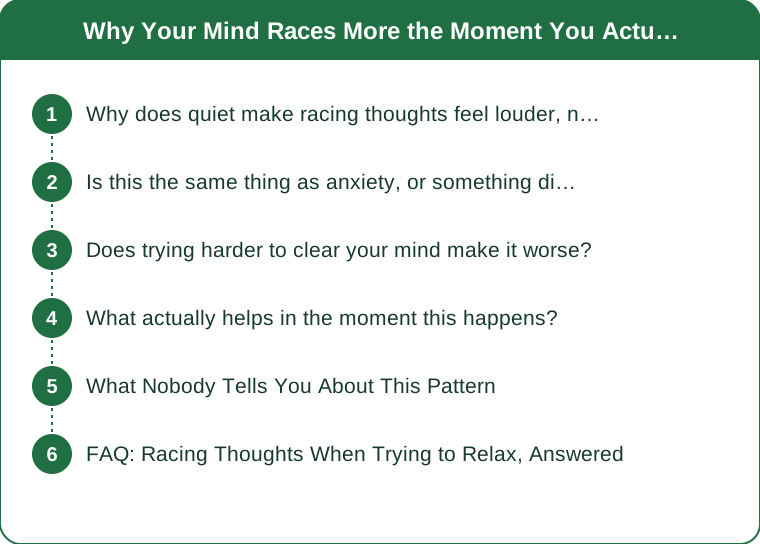
Why does quiet make racing thoughts feel louder, not quieter?
Throughout a busy day, your attention is constantly redirected by external tasks — emails, conversations, decisions — which functions as a kind of ongoing distraction from unprocessed thoughts and worries sitting in the background. The moment that external stimulation stops, as it does when you sit down to relax, those background thoughts finally have room to surface, which can feel like relaxation is causing the racing mind when it’s actually just revealing what was already there.
Is this the same thing as anxiety, or something different?
It overlaps with anxiety but isn’t identical — this pattern, sometimes called the ‘relaxation-induced anxiety’ effect, can happen even in people who don’t otherwise experience significant anxiety day-to-day, simply because unprocessed mental content needs somewhere to go once external distraction disappears. For people who do experience broader anxiety, this effect tends to be more pronounced and harder to sit through.
Does trying harder to clear your mind make it worse?
Often, yes — actively trying to suppress or stop thoughts tends to backfire, a well-documented psychological pattern sometimes called the rebound effect, where effortful thought suppression paradoxically increases the frequency of the exact thought you’re trying to avoid. Allowing thoughts to pass through without immediately trying to shut them down usually works better than fighting them directly.

What actually helps in the moment this happens?
A brief transition activity — a few minutes of light movement, journaling, or a short walk between ‘busy mode’ and ‘rest mode’ — gives racing thoughts somewhere to land before you attempt full stillness, rather than expecting an abrupt switch from high stimulation straight to quiet meditation. Jumping directly from a chaotic day into silent stillness is often exactly what triggers the most noticeable racing-thoughts response.
What Nobody Tells You About This Pattern
Most relaxation advice assumes the goal is immediate stillness, but for a racing mind, a structured, gently occupying activity (like slow journaling or a body scan with a script to follow) often works better as a first step than open-ended silent sitting, precisely because it gives the mind something to do while it winds down rather than nothing at all.
FAQ: Racing Thoughts When Trying to Relax, Answered
Is it normal for this to happen every single time I try to relax?
It’s common, especially after high-stimulation days, though the intensity often decreases with a consistent wind-down routine over several weeks.
Should I give up on meditation if this keeps happening?
No — trying a more structured, guided practice rather than open silent sitting is often a better fit for a racing mind than abandoning the practice entirely.
When does this cross into something worth professional support?
If racing thoughts consistently prevent rest or sleep and feel distressing rather than just noticeable, that’s worth discussing with a therapist. This is general information, not medical advice.
TL;DR:
- Racing thoughts on rest often surface because daytime distraction was masking them, not because relaxing causes them
- Actively suppressing thoughts tends to backfire and increase their frequency
- A brief transition activity between busy and rest modes eases the shift
- Structured, guided practices often work better than open silent sitting for a racing mind
Next time this happens, try a short transition activity before sitting in silence — it’s often the missing step, not a sign you’re bad at relaxing.
Keep Reading
This article is for general informational and styling purposes only. Fit, sizing, and product availability may vary.