Why Does Anxiety Spike When the Seasons Change?

Quick Answer: Anxiety often spikes at the change of seasons because daylight loss shifts your circadian rhythm and melatonin timing, disrupts the routines that were quietly regulating your nervous system all summer, and asks your body to adjust faster than it’s built to. This is distinct from full Seasonal Affective Disorder, which is a diagnosable depressive condition. Most people feel a milder, temporary version: more edge, more restlessness, a harder time settling at night.
If you’ve noticed yourself feeling more on-edge the last week or two and can’t quite point to why, you’re not imagining it, and you’re not just “being dramatic about fall.” Late September is one of the fastest daylight-loss windows of the entire year in most of the US, and your nervous system is built to notice changes in light faster than almost anything else. This is general information, not medical advice.

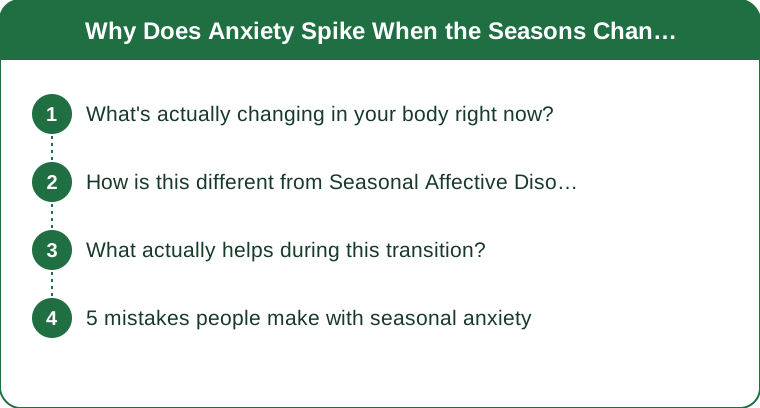
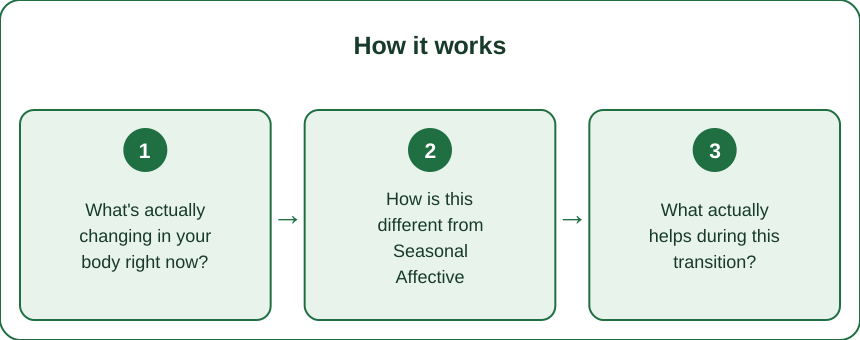
What’s actually changing in your body right now?
Around the autumn equinox, the US loses roughly two to three minutes of daylight every single day — more than any other stretch of the calendar. That’s not a slow fade; it’s a measurable, compounding shift your brain tracks in real time through a cluster of cells in your retina that talk directly to your suprachiasmatic nucleus, the tiny hypothalamic structure that runs your internal clock.
That clock does more than tell you when to sleep. It times your cortisol curve (the hormone that’s supposed to spike in the morning to wake you up and taper by evening) and your melatonin release (which is supposed to start about two hours before you actually feel sleepy). When sunrise gets later and sunset creeps earlier, both of those curves shift — but not always at the same pace, and not always in sync with your alarm clock or your work schedule. The result is a kind of internal jet lag without a plane ride: your cortisol might still be ramping when you’re trying to wind down, which reads in your body as generalized alertness. Not a specific worry. Just a hum of “something is off” that your mind then goes looking for a reason to explain.
This is a genuinely different mechanism than full Seasonal Affective Disorder (SAD), which is a recognized subtype of depression tied to much larger, sustained light deprivation, typically peaking in the darkest months of winter. What you’re likely feeling in late September is milder and more acute: a circadian adjustment period, not a diagnosis. Research on shift workers and frequent travelers shows the body typically needs about one day of adjustment for every hour of circadian shift — and daylight saving time plus the natural equinox slide adds up to a real disruption, even if no clock is technically changing yet.
Layered on top of that biology is something more practical: September is also when routines get rebuilt. School starts. Work schedules compress. The daylight hours you used for a walk, a workout, or just decompressing in the sun quietly disappear from the edges of your day. Your body is adjusting to less light and losing the exact behaviors that used to buffer that adjustment, at the same time.
How is this different from Seasonal Affective Disorder?
It’s worth being precise here, because the two get lumped together constantly and they’re not the same experience.
Seasonal Affective Disorder is a clinical diagnosis — a pattern of major depressive episodes that recur at the same time each year, almost always tied to reduced light exposure in fall and winter, and typically resolving in spring. It comes with the fuller symptom set of depression: low mood most of the day nearly every day, loss of interest in things you normally enjoy, changes in sleep and appetite (often oversleeping and carb cravings, specifically), and it usually needs to persist for about two weeks before it meets criteria. It’s real, it’s treatable, and if what you’re feeling sounds like this, it’s worth talking to a doctor rather than trying to manage it with routine tweaks alone.
What most people feel right now, in the first couple weeks of the seasonal shift, is something narrower: anticipatory anxiety and physical restlessness, not depression. It shows up as a harder time falling asleep, a shorter fuse, more racing thoughts at night, a sense of dread about the day ending or the year “closing in.” It tends to ease within a few weeks as your circadian rhythm catches up to the new light pattern — which is a meaningfully different timeline and a meaningfully different intervention than SAD.
The mistake worth avoiding is deciding you have SAD (or deciding you definitely don’t) based on a bad week. Give it real observation: if the low mood and loss of interest are still there most days after two to three weeks and are affecting your ability to function, that’s worth a conversation with a professional. If it’s mostly nighttime restlessness and daytime edge that’s already easing as you adjust your habits, that tracks much more closely with ordinary circadian adjustment.

What actually helps during this transition?
The single most evidence-backed lever here is morning light exposure, and the mechanism is worth understanding because it changes how you use it. Bright light in the first hour after waking — ideally outdoors, even on a cloudy day, since overcast daylight is still many times brighter than indoor lighting — helps anchor your cortisol spike to the correct time and pulls your melatonin release back to an earlier, more useful hour that night. Ten to twenty minutes is enough to start shifting things within about a week.
Second is protecting the evening wind-down window you may not have realized daylight was giving you for free. When sunset happened at 8pm in July, you had a built-in cue to start easing down. Now that it’s happening closer to 7pm and creeping earlier, that cue arrives while you’re often still mid-workday. Rebuilding an artificial version of that cue — dimming lights, stepping away from screens, a consistent 20-30 minute buffer before bed — does a lot of the same regulatory work the sunset used to do automatically.
Third: expect the adjustment to take one to two weeks, not one night. If you try a single evening of “good sleep hygiene” and still feel wired, that’s not proof it doesn’t work — it’s a normal part of a circadian system that’s genuinely recalibrating. Consistency matters more than intensity here.
And fourth, worth naming plainly: this is a good window to be a little more patient with yourself. If a small thing felt like a big thing this week, some of that really is biological timing, not a character flaw or a sign you’re falling apart.
5 mistakes people make with seasonal anxiety
Mistake 1: Waiting for the feeling to “make sense” before addressing it. You don’t need a specific trigger to justify taking care of your nervous system. Vague, free-floating unease is still unease, and it responds to the same tools as the named kind.
Mistake 2: Getting morning light after you’re already anxious that day, instead of daily. Light exposure works as a cumulative signal to your circadian clock, not a one-time fix. A single sunny walk on a bad morning helps a little; ten consecutive mornings of it recalibrates your whole system.
Mistake 3: Compensating with more caffeine to fight the fatigue of a shifting sleep clock. This is one of the most common traps. Extra afternoon caffeine to push through daytime grogginess directly interferes with the melatonin release you’re trying to fix, extending the very adjustment period causing the fatigue.
Mistake 4: Assuming it’s SAD and catastrophizing the whole season ahead. Deciding in week one that “the next five months are going to feel like this” adds a layer of anticipatory dread on top of a temporary adjustment. Most circadian shifts settle within two to three weeks if you support them.
Mistake 5: Dropping outdoor time altogether once it gets colder or greyer, instead of just shortening it. Ten minutes outside on a 50-degree overcast day still delivers far more lux than any indoor room. The instinct to retreat indoors as it cools is exactly backward from what your circadian rhythm needs most right now.
TL;DR:
- Late September is one of the fastest daylight-loss stretches of the year, and your circadian clock feels every minute of it
- Shifting cortisol and melatonin timing can produce generalized restlessness and edge that your mind then hunts for a reason to explain
- This is different from Seasonal Affective Disorder, which is a diagnosable, sustained depressive condition, not a two-week adjustment
- Morning light, a protected evening wind-down, and about one to two weeks of consistency are the actual levers that help
Your nervous system isn’t overreacting to nothing this week — it’s adjusting to something real, and it knows how to catch up if you give it the light and routine to do it.
Keep Reading
This article is for general informational and styling purposes only. Fit, sizing, and product availability may vary.