Why Do Breathing Exercises Stop Working Mid-Panic?

Quick Answer: Breathing exercises work by engaging your vagus nerve and parasympathetic nervous system, but that engagement requires your prefrontal cortex to still have enough control to direct a slow, deliberate breath — and a full panic spike temporarily reduces exactly that access. There’s a real window early in rising anxiety where breathing techniques are highly effective, and a later point, once a spike has peaked, where the body needs different tools entirely.
If you’ve ever tried to count your breath during a full-blown panic attack and felt like it was making things worse instead of better, that’s not you doing it wrong — it’s a real physiological threshold you’d already crossed before you started. This is general information, not medical advice.

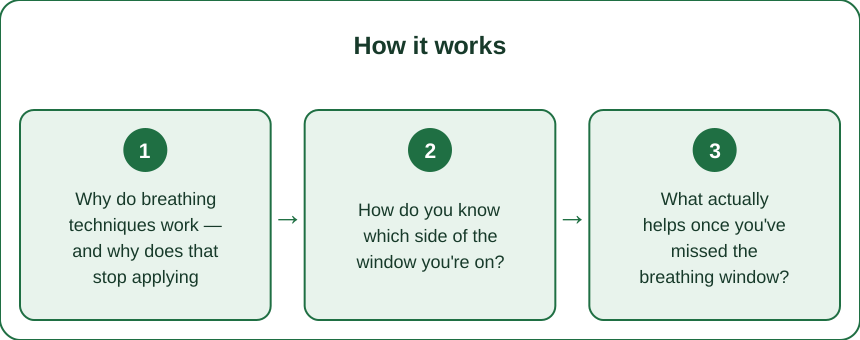
Why do breathing techniques work — and why does that stop applying mid-spike?
Slow, controlled breathing — particularly extending the exhale longer than the inhale — works by directly stimulating the vagus nerve, the primary channel through which your parasympathetic (“rest and digest”) nervous system talks to your heart and lungs. A longer exhale specifically slows heart rate and nudges your body out of sympathetic activation. This is genuinely well-supported physiology, and it’s why breathing techniques are taught so widely.
But there’s a catch built into the mechanism: directing a slow, deliberate breath pattern is an executive function task. It requires your prefrontal cortex — the part of your brain responsible for deliberate, effortful control — to be running the show, holding a count, and overriding your body’s automatic breathing pattern.
Early in a rising anxiety spike, your prefrontal cortex is still largely online, which is exactly why breathing techniques are so effective at that stage — you’re using a still-functional control system to redirect a system that’s only starting to escalate. But once anxiety crosses into a full panic response, your amygdala effectively hijacks priority from your prefrontal cortex — a well-documented pattern sometimes called an amygdala hijack. Blood flow and processing priority shift toward rapid threat response and away from deliberate, effortful reasoning. At that point, asking yourself to hold a precise four-count breath is asking the exact brain system that’s currently least available to do the most demanding task on the list.
This is also why breathing sometimes feels like it makes things worse mid-spike, not just neutral: focusing hard on your breath while you can’t get it to behave the way the technique promises can itself become a new source of frustration and threat-signal, adding to the spiral instead of interrupting it.
How do you know which side of the window you’re on?
The honest answer is that the window isn’t marked by a clock — it’s marked by a few recognizable signs, and they’re worth learning to notice in yourself specifically.
You’re likely still in the effective window if: you can follow a count without losing your place, your thoughts are racing but still somewhat linear, you can still answer a simple question like “what day is it,” and the anxiety feels like it’s rising rather than already at a peak. This is the window where a 4-7-8 pattern (inhale 4 counts, hold 7, exhale 8) or simple extended-exhale breathing has the most room to work, because your prefrontal cortex still has enough bandwidth to run it.
You’re likely past the window if: you’ve lost the count multiple times and can’t seem to hold it, your chest feels physically tight or you feel like you can’t get a full breath no matter what you do, your thoughts have stopped forming into anything linear, or you feel a strong urge to flee the situation regardless of whether that makes sense. At this point, the goal isn’t to fix your breathing — pushing harder on breath control here often backfires, because you’re demanding more from a system that’s currently least resourced to deliver it.
There’s no failure in crossing this line. Panic responses aren’t a sign the techniques don’t work or that you’re bad at managing anxiety — they’re a sign your body correctly detected enough threat signal to override deliberate control, which is precisely what that system evolved to do. The useful move isn’t to fight that override; it’s to switch to tools built for it.
What actually helps once you’ve missed the breathing window?
Once you’re past the point where deliberate breath control is accessible, the goal shifts from calming down to grounding down — tools that don’t require executive function to work.
Cold and strong sensory input bypass the prefrontal cortex almost entirely. Splashing cold water on your face, holding an ice cube, or stepping outside into cold air triggers the mammalian dive reflex, which slows heart rate through a direct physiological pathway rather than a cognitive one. This is one of the few interventions shown to work even when someone is too dysregulated to follow verbal instructions.
5-4-3-2-1 grounding uses your senses instead of your reasoning. Naming five things you can see, four you can touch, three you can hear, two you can smell, and one you can taste doesn’t ask you to control anything internal — it redirects attention outward, which is a lighter cognitive lift than managing a breath count, and it still interrupts the spiral.
Let the physical symptoms run their course instead of fighting them. A racing heart and shortness of breath during a panic spike, while intensely uncomfortable, are not medically dangerous on their own for most people, and panic responses have a natural ceiling — they reliably peak and then decline, typically within roughly 10-20 minutes, even with no intervention at all. Reminding yourself “this has a ceiling, it will come down” is doing real work, even when it doesn’t feel like it in the moment.
Come back to breathing after the peak has passed, not during it. Once the sharpest edge has started to recede — often signaled by thoughts starting to form more linearly again — that’s when breath work regains its footing, and it’s genuinely useful for guiding the tail end of a spike back down to baseline.
5 mistakes people make with breathing during a panic spike
Mistake 1: Starting the breathing technique for the first time mid-spike. A technique you’ve never practiced is much harder to execute under the exact conditions that make execution hardest. Practicing extended-exhale breathing during calm moments builds it into something closer to automatic, which holds up better when a spike does happen.
Mistake 2: Forcing a precise count when you’ve already lost the ability to hold one. If you’ve tried the 4-7-8 count three times and keep losing track, that’s useful information, not a reason to try a fourth time — it’s telling you you’re past the window and need a different tool.
Mistake 3: Treating a failed breathing attempt as proof something is medically wrong. Feeling like you “can’t breathe” during panic is an extremely common symptom of the panic response itself, not usually a sign of a separate physical problem — though any new or unfamiliar chest symptoms should always be discussed with a doctor to rule that out properly.
Mistake 4: Fighting the physical sensations instead of letting the natural peak-and-decline happen. Actively battling a racing heart tends to add a second layer of alarm on top of the first, extending the spike. Naming it and waiting it out is often more effective than trying to override it.
Mistake 5: Judging yourself for “failing” at the breathing technique. The technique didn’t fail and neither did you — you crossed a real, well-documented physiological threshold where a different set of tools becomes more appropriate. Knowing that threshold exists is itself a useful piece of preparation for next time.
TL;DR:
- Breathing techniques work by using your prefrontal cortex to direct the vagus nerve — a system that’s largely offline once a full panic spike takes over
- There’s a real early window (rising anxiety, still-linear thoughts) where breath work is highly effective, and a later point where it isn’t
- Past that window, grounding tools that don’t require executive function — cold water, the dive reflex, 5-4-3-2-1 grounding — work better than forcing a breath count
- Panic responses have a natural ceiling and typically peak and decline within 10-20 minutes even without intervention, and breathing becomes useful again once the sharpest edge passes
Missing the breathing window isn’t a failure of the technique or of you — it’s your body doing exactly what it’s built to do, and knowing where that window closes is what lets you reach for the right tool instead of the wrong one.
Keep Reading
This article is for general informational and styling purposes only. Fit, sizing, and product availability may vary.