Why Did My Calming Routine Stop Working Once Fall Got Busy?

Quick Answer: Your summer calming routine likely stopped working not because it was flawed, but because it was built for a slower, more spacious schedule — and fall compressed the exact conditions (time, quiet, low baseline stress) that made it effective in the first place. The fix usually isn’t a new routine; it’s resizing the one you have to fit less time and a higher-stress baseline.
If ten minutes of meditation used to genuinely calm you down in July and now it just feels like one more thing on the list, that’s not a personal failure or proof the practice “doesn’t work for you.” It’s a mismatch between the tool and the conditions it was designed under. This is general information, not medical advice.
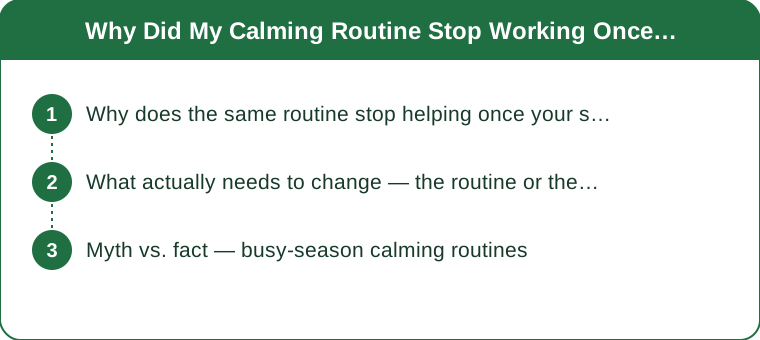
Why does the same routine stop helping once your schedule fills up?
Most calming practices — meditation, slow breathing, journaling — work through a shared mechanism: they activate your parasympathetic nervous system, the “rest and digest” branch that counteracts the stress-driven sympathetic response. But that activation isn’t instant. It requires your baseline arousal to be low enough, and your available time to be unhurried enough, for your body to actually downshift rather than just performing the motions of downshifting.
In summer, most people have a lower resting stress load: lighter schedules, more daylight hours for movement, fewer competing obligations stacked into the same window. A 10-minute meditation session against that backdrop has room to actually work — you’re starting from a 3-out-of-10 stress level, and it brings you to a 1.
In fall, back-to-school logistics, ramped-up work quarters, and shorter daylight compress into the same calendar. Your resting stress level going into that same 10-minute session might now be a 7-out-of-10. The session isn’t broken — it’s being asked to do three times the work in the same amount of time, often while you’re also mentally rehearsing the next four things on your to-do list. Research on stress recovery consistently shows that recovery practices are dose-and-context dependent: the same intervention produces measurably less physiological effect (lower heart-rate-variability improvement, smaller cortisol drop) when performed under high time pressure or with divided attention, compared to relaxed conditions.
There’s also a subtler shift: in summer, you likely did your calming routine proactively, before stress built up. In a busier fall schedule, it’s common to slide into doing it reactively — squeezed in at 11pm as damage control after an already stressful day. A parasympathetic-activating practice has to work much harder to pull you down from an already-elevated state than to keep you from climbing in the first place. Same routine, radically different starting line.
What actually needs to change — the routine or the timing?
The instinct when something stops working is to replace it: switch apps, try a new technique, decide meditation “just isn’t for you.” Usually the more accurate fix is smaller and less dramatic than that.
Move it earlier, not later. If your calming practice has drifted to the last slot of the day — after everything else is handled — you’re asking it to undo a full day of accumulated stress in one sitting. Shifting even a 5-minute version to mid-morning or midday, before the stress stacks up, does more real work than a longer session at night fighting an uphill battle.
Shrink the dose to match the time you actually have, rather than skipping it when you can’t hit the old length. A 10-minute practice that gets skipped three days a week because “there’s no time” delivers less total regulation than a genuinely consistent 3-minute version. Nervous system regulation compounds with frequency more than duration — a short daily practice reliably outperforms a longer, inconsistent one over a two-week window.
Separate the practice from the phone that’s also pinging you with everything else. In summer, a breathing app on your phone was probably just a breathing app. In a busier fall, that same phone is now interrupting you with school pickup reminders, work Slack, calendar alerts — all competing for the same five minutes you carved out. If you can, use a dedicated timer instead of an app on the device generating your stress, or put the phone in Do Not Disturb specifically for that window.
Expect less from any single session, and judge the routine over two weeks, not one sitting. A busier season doesn’t just compress your time — it raises your baseline. A session that only gets you from a 7 to a 5 isn’t a failure; it’s still real regulation, just measured against a harder starting point than summer gave you.
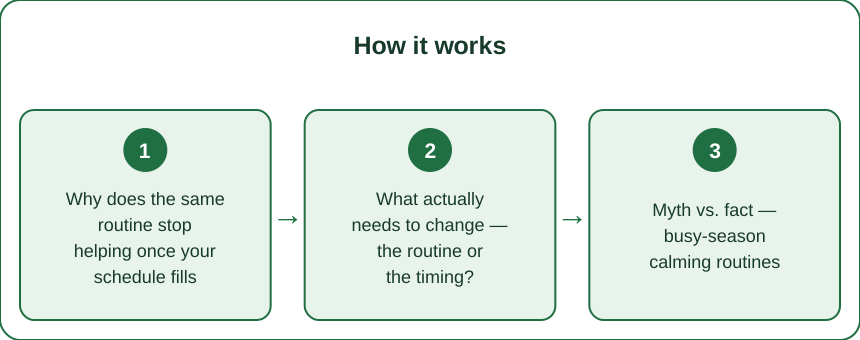
Myth vs. fact — busy-season calming routines
Myth: “If it’s not calming me down the way it used to, it’s stopped working.” Fact: The practice’s mechanism (activating the parasympathetic nervous system) hasn’t changed. What’s changed is your starting stress level and the time you’re giving it to work against that higher baseline. A tool doing less against a bigger problem isn’t a broken tool.
Myth: “I need to find a completely different technique for fall.” Fact: Most people don’t need a new modality — they need the same one resized. Switching techniques every time life gets harder means you never build the familiarity that makes any practice faster-acting over time; your nervous system responds better to techniques it recognizes.
Myth: “Skipping it on the busiest days and doing a longer session on calmer days evens out.” Fact: Regulation is closer to strength training than a bank account — irregular, inconsistent practice doesn’t average out to the same benefit as steady, shorter sessions, because you lose the conditioning effect between sessions.
Myth: “If I’m too stressed to sit still for it, that means I need it more, so I should push through the full length.” Fact: When your baseline arousal is very high, a shorter, simpler version (even just 90 seconds of slow exhale-focused breathing) is often more achievable and more effective than forcing the full 10-minute format you no longer have the bandwidth to actually settle into.
Myth: “This is just what fall feels like now, there’s nothing to adjust.” Fact: The compression is real, but it’s a scheduling and timing problem with a scheduling and timing fix — not a permanent downgrade in how much calm is available to you this season.
TL;DR:
- Calming routines rely on lowering your baseline stress enough for your parasympathetic system to actually engage — a busier fall schedule raises that baseline and shrinks your time, so the same routine has to work much harder
- The fix is almost always resizing the practice (shorter, earlier, more consistent) rather than replacing it entirely
- Moving your practice earlier in the day, before stress accumulates, beats a longer session squeezed in at night
- Judge results over two weeks of consistency, not a single session against a harder starting point than summer gave you
Your routine didn’t lose its power — your season just got louder, and it needs a smaller, earlier version of the same thing to cut through.
Keep Reading
This article is for general informational and styling purposes only. Fit, sizing, and product availability may vary.