Why 3am Worry Feels Bigger Than the Same Worry at 3pm

Quick Answer: Waking at 3am with amplified worry is largely physiological. Cortisol is rising toward its morning peak, you are surfacing from REM sleep with high emotional reactivity, and the prefrontal regions that provide perspective are the last part of the brain to come fully online. Your problem-solving is running with the alarm system loud and the judgment system offline. The most effective responses are to stop trying to solve anything, get out of the loop physically, and defer the thought to a specific daytime slot.
At 3am, the awkward email is a career-ending catastrophe. At 8am, over coffee, it is an awkward email. Nothing about the situation changed in five hours. Everything about the brain evaluating it did.

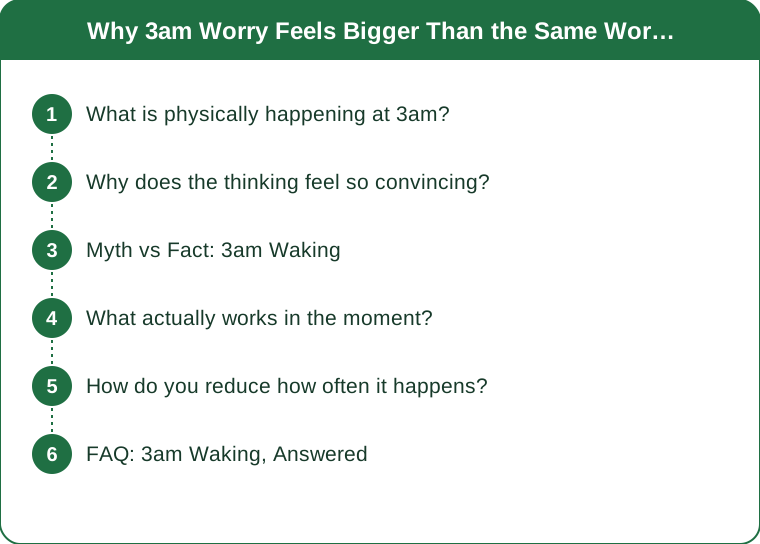
What is physically happening at 3am?
Your cortisol is climbing. The cortisol awakening response starts building in the last hours of sleep, usually from around 2 to 3am, peaking shortly after you wake. Cortisol is the mobilization hormone, and its rise increases alertness and threat sensitivity. You are being chemically prepared for action at the exact moment there is nothing to act on.
You are surfacing out of REM-dense sleep. The back half of the night is heavy in REM, a state of high limbic activity and vivid emotional processing. Waking directly out of it means waking with the emotional system already running hot.
Your prefrontal cortex is the slowest thing in the room. The regions that supply context, proportion, and the ability to say this can wait until Tuesday take substantially longer to reach full function than the amygdala does. For the first stretch of a night waking, you have full threat detection and almost no perspective.
Body temperature is at its lowest point, too, which is associated with lower mood generally. Every relevant system is tilted the same direction at once.
Why does the thinking feel so convincing?
Because the content is real and only the weighting is wrong. 3am does not usually invent problems. It takes genuine ones and strips out the mitigating context - that you have handled similar things before, that other people have a role in this, that there are steps available tomorrow.
What you get is a problem with the solutions deleted. That is why the thinking feels both true and unbearable, and why arguing with it never works. You cannot reason your way out with the reasoning system offline.
Darkness and silence remove your calibration. In daylight there are competing inputs - people, tasks, sound - that keep any single thought from filling the whole field. At 3am the thought is the only thing in the room.
And it loops rather than progresses. Notice that in an hour of 3am thinking you never reach a conclusion. You circle the same three sentences. That looping is the diagnostic sign that this is a physiological state, not a thinking session.
Myth vs Fact: 3am Waking
Myth: waking in the night means something is wrong with your sleep. Fact: brief night wakings are completely normal and common across all adults. Most people have several and do not remember them. Anxiety is what turns a normal waking into a remembered one.
Myth: if you are awake anyway, you may as well think it through. Fact: 3am problem-solving is measurably worse than the same problem-solving at 10am, and it strongly reinforces the habit of waking to worry.
Myth: checking your phone helps you settle. Fact: it extends the waking, adds new inputs to worry about, and the light delays your return to sleep.
Myth: you should stay in bed and try harder to sleep. Fact: staying in bed awake and distressed trains your brain to associate the bed with alertness. If you are awake and wound up after about 20 minutes, get up.
Myth: it means you have an anxiety disorder. Fact: the 3am pattern is close to universal during stressful periods. It becomes clinically relevant when it happens most nights for weeks and affects your daytime functioning.

What actually works in the moment?
Stop trying to solve it. That is the whole first move. Say to yourself, explicitly: this is a 3am thought, my judgment is offline, this gets addressed at 9am. Not as a positive affirmation - as an accurate statement about your neurochemistry.
Get out of the bed if you are still spinning after about 20 minutes. Go to another room, keep the lights very low, and do something undemanding and boring. Not the phone. A dull book, a wordless task, folding something.
Change your body position and temperature. Sitting up and putting your feet on a cool floor gives your nervous system a genuinely different set of inputs, which interrupts the loop faster than trying to think differently does.
Try a slow exhale pattern. Breathe in for 4, out for 6 or 8. The extended exhale activates the parasympathetic branch and lowers heart rate within a couple of minutes. It will not make you happy; it will lower the volume enough that sleep becomes possible.
Write down one sentence and close the notebook. Not a plan - one line naming the thing. This gives your brain permission to stop rehearsing it in order to remember it, which is a real part of what the loop is doing.
Then go back to bed only when you feel sleepy, not when you feel calm. Those are different states and waiting for the wrong one keeps you up.
How do you reduce how often it happens?
Schedule worry time during the day. Fifteen minutes, same time daily, ideally late afternoon rather than evening. Write the concerns down and, crucially, write the next action for each. Brains rehearse unresolved items at night; an item with a named next step is much less likely to be one of them.
Watch alcohol specifically. A drink or two in the evening reliably produces waking in the second half of the night as it is metabolized, and it does so with elevated heart rate and a strongly primed anxiety response. If your 3am wakings cluster on certain nights, look here first.
Keep the wake time constant, even after a bad night. Sleeping in to compensate shifts your body clock and makes the following night worse. This matters especially in early autumn, when the shortening evenings are already nudging your clock around.
Get morning light within an hour of waking. Ten to fifteen minutes outdoors anchors the whole circadian system, which lowers the odds of a disorganized 3am rise. This is the highest-value habit change for chronic night waking.
Do not check the time when you wake. Knowing it is 3:12 adds arithmetic about how much sleep you have left, and that arithmetic is itself activating. Turn the clock away from the bed.
FAQ: 3am Waking, Answered
Why is it always around the same time?
Because it tracks your sleep architecture and your cortisol curve, both of which are fairly consistent night to night. It is not a coincidence and it is not meaningful in itself.
Should I take something to get back to sleep?
For an occasional bad stretch, non-drug approaches work better and carry no rebound. If night waking persists most nights for more than a few weeks, that is worth raising with a doctor - persistent middle-of-the-night waking can be linked to sleep apnea, thyroid issues, or a treatable anxiety condition rather than to stress alone.
Does the worry mean the problem is genuinely serious?
Sometimes yes, but 3am is not the instrument that tells you. Bring the same thought to 10am on purpose - actually sit with it deliberately - and see what it looks like. If it still feels urgent then, it deserves a plan. Usually it looks like a Tuesday task.
This is general information, not medical advice. If night waking with anxiety is persistent, or comes with low mood or hopelessness, please talk to a doctor.
TL;DR:
- Rising cortisol, REM-heavy sleep, and a slow-to-wake prefrontal cortex mean 3am gives you full threat detection with almost no perspective.
- The looping, unresolvable quality of the thinking is the giveaway that this is a physiological state, not a productive thinking session.
- In the moment: name it as a 3am thought, get up after about 20 minutes, keep lights low, breathe out longer than you breathe in, write one line and stop.
- To reduce frequency: daytime worry time with named next actions, consistent wake time, morning light, and a hard look at evening alcohol.
The thought is not bigger at 3am. You are smaller at 3am. Put it down, and pick it up in the morning when you have the whole brain available to hold it.
Keep Reading
This article is for general informational and styling purposes only. Fit, sizing, and product availability may vary.