The Two-Minute Reset That Works When You Have No Time and No Privacy

Quick Answer: The fastest reliable reset is an extended exhale - breathe in for about 4 seconds, out for about 8, for roughly two minutes. A longer exhale than inhale increases parasympathetic activity and lowers heart rate, and unlike most techniques it requires no privacy, no equipment, and no visible movement. It is the only calming method you can run in the middle of a meeting without anyone noticing.
The advice to take a bath and journal about it is not useful at 2:40pm on a Tuesday.
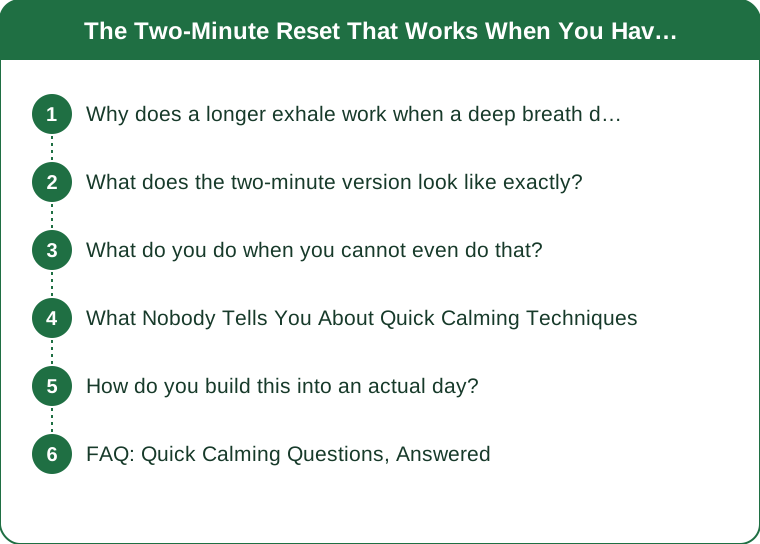
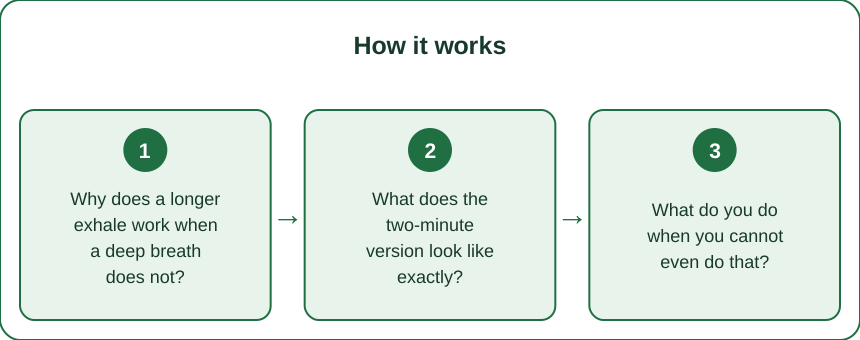
Why does a longer exhale work when a deep breath does not?
Because the two halves of a breath do opposite things to your heart rate, and most people are unknowingly doing the version that speeds it up.
Your heart rate rises slightly on the inhale and falls on the exhale. This is a normal, continuous phenomenon called respiratory sinus arrhythmia, and it reflects the balance between the sympathetic and parasympathetic branches of your autonomic nervous system.
Extending the exhale relative to the inhale shifts that balance toward the parasympathetic side - the rest-and-digest side. This is the mechanism behind essentially every effective breathing technique, whatever name it is sold under.
This is also why taking a big deep breath sometimes makes anxiety worse. A large fast inhale, held, followed by a short exhale, is closer to the breathing pattern of a stress response than a recovery one. People who say breathing exercises do not work for them are frequently doing large inhales, which is the opposite of the effective intervention.
The specific ratio matters less than the direction. 4 in and 8 out is a good target; 4 and 6 works; even 3 and 5 works. The requirement is simply that the out-breath is meaningfully longer than the in-breath, and that you keep it going for long enough to matter.
What does the two-minute version look like exactly?
The whole protocol, in the order you run it.
Step 1 - Anchor your feet, 10 seconds. Both feet flat on the floor. Press them down slightly and notice the contact. This is not a mystical step - it interrupts the attentional loop by giving your awareness a physical target, which is the actual mechanism behind most grounding techniques.
Step 2 - Exhale first, 5 seconds. Do not start with an inhale. Breathe out fully, longer than feels natural, until your lungs are genuinely empty. Starting with the exhale immediately establishes the pattern and empties the stale volume that makes anxious breathing feel shallow.
Step 3 - The cycle, about 90 seconds. In through the nose for a count of 4. Out through the mouth or nose for a count of 8. Do not force the count - if 8 is a strain, use 6. Roughly 8 to 10 cycles.
Step 4 - Unclench, 10 seconds. Jaw, shoulders, hands. These three hold tension you will not notice until you deliberately check them, and releasing them provides physical feedback that something has changed.
Step 5 - One sentence, 5 seconds. Name what is happening in plain language: I am stressed about the 3pm call. Affect labelling - putting feelings into words - is associated with reduced emotional intensity, and doing it silently works.
Total: about two minutes, and none of it is visible from across a room.
The nose detail is worth knowing: nasal breathing slows airflow naturally and is associated with better outcomes than mouth breathing for calming purposes. If your nose is blocked, mouth breathing with a long exhale still works.
What do you do when you cannot even do that?
Sometimes two minutes and a breathing pattern is beyond reach - in the middle of a conversation, or when the arousal level is high enough that concentrating on counting is impossible. There are shorter tools for that.
The physiological sigh - about 10 seconds. Two inhales through the nose, the second one short and stacked on top of the first, then one long slow exhale through the mouth. This is a naturally occurring pattern - it is what a sob or a sigh is - and it is among the fastest interventions available for reducing acute arousal. It can be done once, in the gap in a conversation, and it looks like a sigh because it is one.
Cold on the face - about 20 seconds. Cold water on the wrists, face, or the back of the neck. Cold stimulus to the face triggers a reflexive slowing of heart rate, and this is the most reliable option when arousal is high. A bathroom is enough privacy.
Peripheral vision widening - about 15 seconds. Stop focusing on a point and deliberately soften your gaze to take in the edges of your visual field. Narrow focused vision is associated with alert, stress-linked states, and widening it is one of the few things you can do with your eyes open in a meeting.
The 5-4-3-2-1 scan - about 60 seconds. Five things you can see, four you can hear, three you can feel, two you can smell, one you can taste. Useful specifically when thoughts are racing rather than when the body is activated, because it occupies the attentional resources the rumination is using.
Move, if you can, for 60 seconds. A flight of stairs, a lap of the floor. Movement metabolises circulating stress hormones in a way that sitting still does not, and it is the most underused option in an office.
What Nobody Tells You About Quick Calming Techniques
They work better if you have practised them when you are calm. A technique first attempted at peak stress usually fails, and people conclude it does not work. Two minutes of extended-exhale breathing daily when nothing is wrong builds the pattern, so that under stress you are executing something familiar rather than learning something new.
Reducing arousal is not the same as feeling good. The realistic outcome of two minutes is going from an 8 to a 6, not from an 8 to a 2. Expecting to feel fine afterwards is the expectation that makes people abandon effective tools. A 6 is where you can think again, and that is the point.
The technique that works for you may not be the popular one. Breathing techniques are less effective for people who find interoceptive focus distressing - and for them, external grounding, cold, or movement typically works better. This is a real individual difference, not a failure to try properly.
Trying to stop the anxious thought is counterproductive. Thought suppression tends to increase the frequency of the suppressed thought. Techniques that redirect attention work; techniques that fight the thought do not.
The timing that helps most is before, not during. Two minutes before a known stressor - a meeting, a call, a difficult conversation - is more effective than two minutes in the middle of it. Most people only reach for these tools after arousal has peaked, which is the hardest moment for them to work.
Caffeine has a longer tail than people expect. Its half-life is commonly around 5 to 6 hours, meaning an afternoon coffee is still substantially present in the evening. If your anxiety has a reliable time of day, look at what you drank five hours earlier before concluding the technique is failing.
And the honest one: these are tools for managing acute moments. They do not address a chronic underlying cause, and they are not a substitute for treatment. If anxiety is persistent, interfering with your daily functioning, or accompanied by panic attacks, that is worth speaking to a doctor about. This is general information, not medical advice.
How do you build this into an actual day?
The techniques are easy. Remembering to use them is the hard part, and it is a design problem rather than a discipline problem.
Attach it to something that already happens. After you sit down at your desk. Before you open your laptop. When you park the car and before you go into the house. Habit stacking onto an existing cue is far more reliable than intending to do it when needed.
Put it before your known spikes, not after. Most people can name the two or three moments in a normal week that reliably raise their stress. Two minutes before each is a small, specific, achievable target.
Use the transitions. The gaps between activities are the natural home for this - the walk between meetings, the moment before a call connects, the drive home. Transitions are already dead time, which means the technique costs nothing.
Set exactly one recurring reminder. Mid-afternoon, when most people’s stress and fatigue converge. More than one reminder gets ignored.
Track nothing. Adding a tracking habit on top makes it a task with a compliance record, and the failure to comply becomes another stressor. This should be one of the very few things in your day with no metric attached.
And do it in the good weeks too. The practice has a training effect, and a tool you use only in crises is one you will always be using for the first time.
FAQ: Quick Calming Questions, Answered
How long until I feel a difference?
Often within 60 to 90 seconds for physical arousal - heart rate, tension. The mental settling usually lags a little behind and continues for several minutes after you stop.
Does it still work if I do not believe it will?
The physiological mechanism does not require belief - a longer exhale affects heart rate regardless. Expectation influences the subjective experience, so scepticism may blunt how much better you feel while the physiology still shifts.
Can I do this during a panic attack?
Extended exhale breathing is commonly recommended during panic, and some people find focusing on breathing makes panic worse. If that is you, use cold water or external grounding instead. Recurrent panic attacks are worth discussing with a doctor.
What if counting makes me more anxious?
Drop the numbers and use a physical reference instead - breathe out for the length of a slow hand movement, or until you have finished a long silent word. The ratio matters; the counting does not.
Is this a substitute for therapy or medication?
No. These are acute-moment tools. Persistent anxiety that affects your work, sleep, relationships or daily functioning deserves proper assessment and treatment. This is general information, not medical advice.
TL;DR:
- Exhale longer than you inhale - roughly 4 in, 8 out - for two minutes; the ratio is the mechanism
- Start with an exhale, not an inhale; big deep breaths can make anxiety worse
- No time at all? Physiological sigh, cold water on the face, or widen your peripheral vision
- Practise when calm so the technique is familiar when it matters
- Expect to go from an 8 to a 6, not to zero - that is what success looks like
It works in a stairwell, which is the only place most of us actually have.
Keep Reading
This article is for general informational and styling purposes only. Fit, sizing, and product availability may vary.