The Meditation Technique That Actually Works When Your Mind Won't Stop Racing

Quick Answer: When your mind is racing, trying to go blank usually makes it worse. Instead, use the labeling technique — briefly naming each thought as ‘thinking,’ ‘planning,’ or ‘worrying’ as it arises, then returning to the breath. It works with the racing instead of fighting it.
You sit down to meditate, close your eyes, and within ten seconds your brain is already three tabs deep into tomorrow’s to-do list. So you try harder to clear your mind, which somehow makes it worse.

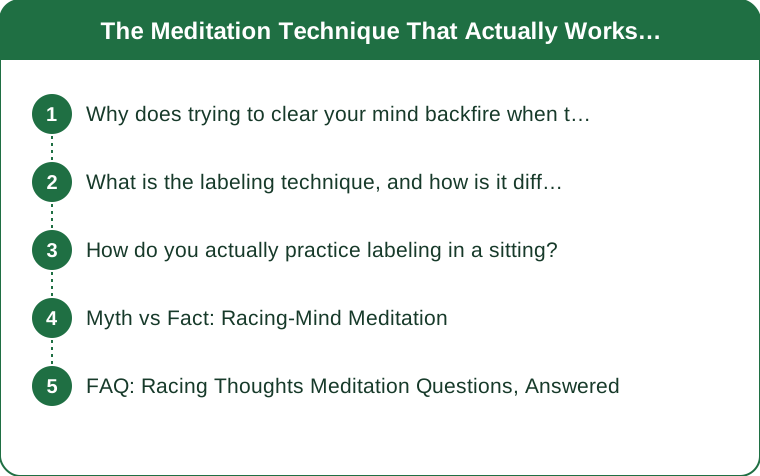
Why does trying to clear your mind backfire when thoughts are racing?
Actively suppressing a thought takes mental effort, and that effort itself becomes a new thing to think about — psychologists call this the rebound effect. The instruction ‘don’t think about anything’ is nearly impossible to follow because checking whether you’re succeeding requires thinking. Racing-mind days need a different approach than calm-mind days.
What is the labeling technique, and how is it different from focusing on the breath?
Instead of trying to hold attention on the breath alone, you briefly and silently label each thought as it appears — ‘planning,’ ‘worrying,’ ‘remembering’ — then let it go and return to the breath. This gives the racing mind somewhere to land rather than something to suppress, which is why it tends to work better than plain breath focus on high-distraction days.

How do you actually practice labeling in a sitting?
Sit comfortably, close your eyes, and take a few slow breaths. When a thought pulls your attention away, silently note its category in one or two words, then return to the breath sensation. You’ll likely need to do this 15-20 times in a single 5-minute session on a racing-thoughts day — that repetition is normal, not a sign you’re failing.
Myth vs Fact: Racing-Mind Meditation
Myth: A racing mind means you’re bad at meditation. Fact: noticing that your mind wandered is literally the skill being trained — every return to the breath is a successful rep, not a failure.
Myth: You need silence and zero distractions to meditate well. Fact: labeling works specifically because it’s built for a noisy environment, mental or physical — it doesn’t require ideal conditions.
Myth: More minutes always means more benefit. Fact: five focused minutes using labeling on a hard day often produces more calm than twenty minutes spent frustrated and fighting your own thoughts.
FAQ: Racing Thoughts Meditation Questions, Answered
How long before labeling starts to feel natural?
Most people notice it feels less effortful after about two weeks of daily practice, even just five minutes a day, since the labeling becomes closer to automatic.
Can this technique help with anxiety specifically, or just general busy-mindedness?
It’s used in several clinical anxiety protocols because naming a worry thought reduces its emotional intensity slightly compared to just experiencing it unlabeled — though it’s a coping tool, not a treatment for diagnosed anxiety disorders.
What if labeling itself starts to feel like just another racing thought?
That’s a sign to simplify further — drop to a single label like ‘thinking’ for everything, rather than trying to categorize precisely, which removes the extra mental work of choosing the right word.
TL;DR:
- Trying to go blank when your mind is racing usually backfires and adds mental effort
- Labeling each thought briefly (‘planning,’ ‘worrying’) before returning to the breath works with a racing mind instead of against it
- Expect to relabel 15-20 times in a single 5-minute session on a hard day — that’s normal, not failure
- Five focused minutes with labeling often beats twenty frustrated minutes
Next time your mind won’t settle, skip trying to clear it and just start naming what shows up.
Keep Reading
This article is for general informational and styling purposes only. Fit, sizing, and product availability may vary.