The Physiological Sigh: The 60-Second Anxiety Reset Neuroscientists Actually Recommend
Quick Answer: The physiological sigh is two quick inhales through the nose followed by one long exhale through the mouth. Repeated 1-3 times, it lowers heart rate and calms your nervous system faster than slow breathing alone, according to Stanford research.
Your chest is tight, your thoughts are looping, and you don’t have ten minutes for a guided meditation app. You need something that works in the time it takes to wait for a text reply back. This is that thing, and it takes less than a minute — no app, no quiet room, no lying down required.

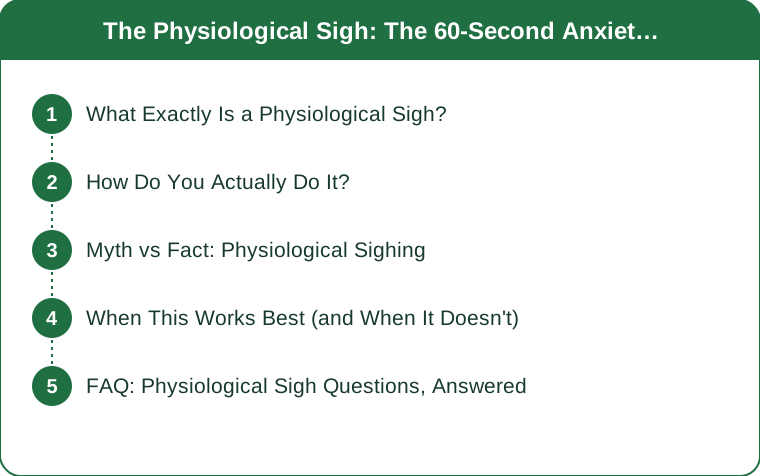
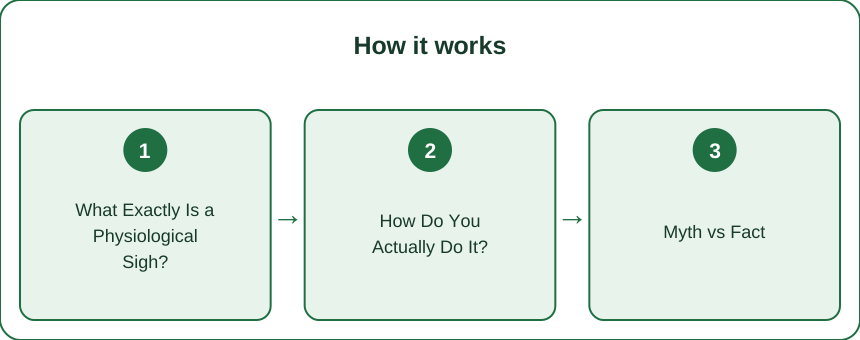
What Exactly Is a Physiological Sigh?
It’s a breathing pattern your body already does on its own when you cry, laugh hard, or fall asleep after a big emotional release: two inhales through the nose back to back, then one long, slow exhale through the mouth. The double inhale re-inflates tiny collapsed air sacs in your lungs called alveoli, which lets you offload more carbon dioxide on the exhale that follows than a single normal breath would.
That exhale is the actual mechanism doing the work. Long, controlled exhales activate your vagus nerve — the main highway between your brain and your organs that governs the parasympathetic, ‘rest and digest’ side of your nervous system — and they do it faster and more reliably than any other single breathing cue researchers have tested, including slow diaphragmatic breathing or box breathing on its own.
How Do You Actually Do It?
Breathe in through your nose until your lungs feel about 80% full — roughly 2 seconds. Without exhaling, take a second short, sharp sip of air through your nose to top the lungs off completely, filling the very last bit of lung capacity. Then exhale slowly through your mouth for about 6 to 8 seconds, roughly twice as long as the combined inhale took.
That’s one full cycle. Do 1 to 3 cycles back to back. Most people notice their shoulders drop and their jaw unclench by the second cycle, and a measurable dip in heart rate is often noticeable by the third. Unlike longer breathwork practices, there’s no ramp-up period — the effect starts on the very first exhale.
Myth vs Fact: Physiological Sighing
Myth: you need a long session, like a full breathwork class, for it to count. Fact: a 2023 Stanford study (Balban et al., published in Cell Reports Medicine) found that just 5 minutes of physiological sighs daily reduced anxiety and improved mood more over a month than an equivalent amount of time spent on mindfulness meditation or slow-paced breathing — and a single cycle measurably lowers physiological arousal within seconds, well before the 5-minute mark.
Myth: it only works lying down in a quiet room with your eyes closed. Fact: it works standing in a checkout line, sitting in a meeting with your eyes wide open, or gripping a steering wheel at a red light. Nobody around you needs to know you’re doing it, since the inhales and exhale don’t require any visible posture change.
Myth: more cycles is always better. Fact: research participants who did the technique for 5 minutes daily saw benefits plateau rather than keep climbing linearly — the point isn’t marathon sessions, it’s frequent, short applications exactly when a spike hits.
When This Works Best (and When It Doesn’t)
It’s built for acute spikes: the jolt before a presentation, the tight chest after a hard email, waking up at 3am with your mind racing, the few seconds before walking into a difficult conversation. Use it in the moment the anxiety hits, not only as a once-a-day scheduled ritual, though a daily practice on top of in-the-moment use compounds the benefit according to the research.
What it isn’t: a treatment for a diagnosed anxiety disorder or panic disorder on its own, and it won’t resolve the underlying source of chronic stress if that source (a job, a relationship, a health issue) isn’t also being addressed separately. Think of it as a fast circuit-breaker for the physical sensation of anxiety, not a substitute for therapy or medication if you need either. This is general information, not medical advice — talk to a professional if anxiety is interfering with daily life or lasting beyond what feels manageable on your own.
FAQ: Physiological Sigh Questions, Answered
How many times a day can I do this?
As many as you need — there’s no upper limit or diminishing-returns cutoff documented in the research. Some people default to it dozens of times during a stressful week and that’s completely fine; it’s a low-effort, zero-cost tool with no known downside from frequent use.
Is this the same as box breathing?
No. Box breathing uses equal counts (4-4-4-4 inhale-hold-exhale-hold), while the physiological sigh is deliberately asymmetric — a short double inhale and a long exhale, with no hold at all. The exhale-dominant, hold-free pattern is what triggers the faster nervous-system shift in the Stanford comparison, which specifically tested it against both box breathing and standard mindfulness meditation.
Can it actually help me fall back asleep at 3am?
Yes. Lie still, close your eyes, and do 3 to 5 cycles without checking your phone in between rounds. Most people feel noticeably heavier and calmer by the fourth cycle, and the absence of a screen check in between matters — light exposure at 3am works directly against the calming effect you’re trying to build.
TL;DR:
- Two quick inhales through the nose (a full breath, then a short top-off sip), then one long exhale through the mouth
- 1-3 cycles is enough to blunt an acute anxiety spike; more isn’t necessarily better
- Works anywhere — a checkout line, a meeting, your bed at 3am — with no visible posture change needed
- A 2023 Stanford study found it outperformed meditation and box breathing for daily anxiety reduction
- Not a replacement for treating a diagnosed anxiety or panic disorder
The next time your chest tightens before something stressful, skip the ten-minute app session and try three cycles instead. It costs you 60 seconds, there’s nothing to set up, and the research suggests it may work better than the longer alternative you were about to reach for anyway.
Keep Reading
This article is for general informational and styling purposes only. Fit, sizing, and product availability may vary.