Why Meditation Feels Impossible When You Are Angry (Not Anxious)

Quick Answer: Anger is a high-energy state, and sitting still with it usually makes it louder. Discharge the physical charge first — 60 seconds of hard movement or a long exhale sigh — then sit. Meditating from anger fails; meditating after metabolizing it works.
You close your eyes. Ten seconds later you are re-arguing the thing that made you angry, but with better lines this time.
That is not a discipline problem. Anger and anxiety feel similar from the inside, but they behave completely differently on the cushion — and almost every app you have tried was written for the other one.

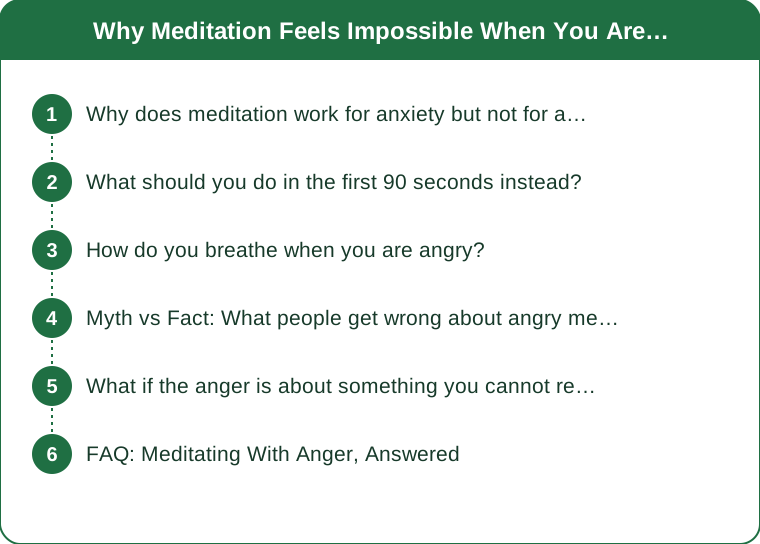
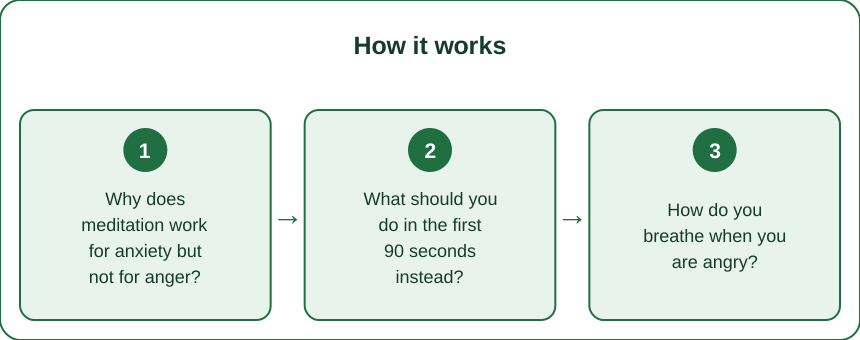
Why does meditation work for anxiety but not for anger?
Anxiety is mostly forward-facing: your body is bracing for something that has not happened. Stillness helps because it gives your nervous system evidence that nothing is actually attacking you right now.
Anger is backward-facing and action-oriented. Something already happened, and your body has mobilized to do something about it — heart rate up, jaw clenched, hands warm, muscles primed. Sitting still asks you to hold all that mobilization with nowhere to send it.
So the energy loops. You replay the conversation, you draft the text you will not send, you win the argument three times. Ten minutes later you are angrier than when you started, and you conclude you are bad at meditating.
You are not. You skipped a step that anxiety meditation does not need.
What should you do in the first 90 seconds instead?
Discharge before you sit. The goal is not to calm down — it is to give the mobilized energy somewhere to go so stillness stops fighting it.
Pick one, 60 to 90 seconds, at real effort:
- 20 fast squats or 15 push-ups. Crude and effective. Anger is metabolic; burn some of it.
- A 30-second isometric push. Press your palms together hard, or push against a wall or doorframe. Full effort for 30 seconds, then release completely. Repeat twice.
- Shake it out. Stand and shake hands, arms, and legs loosely for 60 seconds. It looks ridiculous. It works.
Then sit — and only then. The rule is simple: if your jaw is still clenched, you are not ready to sit yet. Check it with your fingers. A relaxed jaw is your green light.
How do you breathe when you are angry?
Skip box breathing. Equal-count patterns are stabilizers — great for anxiety, too neutral for a state this activated.
Use a long-exhale ratio instead: in for 4, out for 8, through slightly pursed lips. Six to eight rounds, about 90 seconds. The extended exhale is the part that pulls your heart rate down; the inhale length barely matters.
If 8 feels impossible at first, that is normal — start at in 4, out 6, and stretch it as you go. Do not force a count that makes you gasp on the next inhale.
One more that works faster than it should: the physiological sigh. Two inhales through the nose (a full one, then a short top-up sniff), then one long slow mouth exhale. Three rounds. It is the single fastest lever most people have, and it takes about 20 seconds.

Myth vs Fact: What people get wrong about angry meditation
Myth: You should meditate to make the anger go away. Fact: Anger that goes away in ten minutes was usually irritation. Real anger is information about a boundary that got crossed. The goal is to stop it from running you, not to delete it.
Myth: Feeling angry during meditation means you are doing it wrong. Fact: Anger surfacing in stillness is extremely common, especially in the first few weeks of a habit. It often means you finally stopped moving fast enough to notice it.
Myth: You should observe the anger neutrally and let it pass. Fact: Neutral observation is an advanced skill and a terrible starting instruction. Early on, naming beats observing — silently label it: this is anger, it is in my chest and jaw, it is about being dismissed. Specific naming lowers the intensity in a way that vague watching does not.
Myth: Loving-kindness meditation toward the person who angered you is the fix. Fact: Done too early it reads as self-gaslighting and usually backfires. Direct it at yourself first, for weeks, before you point it anywhere else.
What if the anger is about something you cannot resolve?
This is where most people quietly give up, because the technique works and the situation still does not change.
Split the two. The practice is for the physiological charge; it is not a substitute for the conversation, the boundary, or the exit. Confusing them is why people meditate for months on a job that needs quitting.
A practical structure: after your sit, spend three minutes writing two lines. First, what happened, factually — no interpretation, just the sequence of events. Second, what I actually want — stated as a request, not a complaint. Most unresolvable anger turns out to be a request you have not let yourself make out loud.
And if the honest answer is that nothing can change right now, say that on the page too. Naming a situation as genuinely unfixable is a real form of relief — it lets you stop spending energy on the search for a solution that is not there yet.
If anger is spilling into how you treat people you care about, or it is a daily state rather than an occasional one, that is worth raising with a therapist or your doctor. This is general information, not medical advice.
FAQ: Meditating With Anger, Answered
How long should I sit when I am angry?
Shorter than usual. Three to five minutes after discharging, not twenty. Long sits in an activated state mostly give the story more runway. Build the length back up on calm days, not angry ones.
Is it bad to skip meditating on angry days?
No — but replace it rather than dropping it. A 10-minute walk with no podcast does more for an angry nervous system than a forced sit, and it keeps the daily thread intact.
Why do I cry when I try this?
Common, and usually fine. Anger frequently sits on top of hurt, and lowering the activation lets the layer underneath show up. If it happens every single time and feels unmanageable, that is a signal to work with a professional rather than alone on a cushion.
TL;DR: Anger is not anxiety, and the standard advice fails because it treats them the same.
- Discharge first, sit second — 60 to 90 seconds of hard effort, then check your jaw.
- Use long exhales, not equal counts. In 4, out 8, or three physiological sighs.
- Name it specifically instead of observing it neutrally: the emotion, the body location, the trigger.
- Keep the sit short on angry days — three to five minutes beats twenty.
- Separate the practice from the problem; calming your body is not the same as fixing the situation.
The reframe worth keeping: you are not trying to become someone who does not get angry. You are building the 90-second gap between feeling it and acting on it. That gap is the entire skill.
Keep Reading
This article is for general informational and styling purposes only. Fit, sizing, and product availability may vary.