Why Anxiety Spikes in the Late Afternoon and What Actually Settles It

Quick Answer: Late-afternoon anxiety usually has a stacked cause: cortisol has fallen from its morning peak while adrenaline stays elevated, blood sugar is dipping several hours after lunch, caffeine is wearing off, the day’s unfinished tasks are becoming undeniable, and light levels are dropping. Each contributes, none is the whole answer. The interventions that work reliably are eating a protein-containing snack around mid-afternoon, getting outside for ten minutes of daylight, moving for five minutes, and doing a two-minute written brain dump of what is unfinished.
It arrives without an event. Nothing bad happened at 3:40. And yet there it is - the tightness, the sense that something is wrong, the sudden certainty that you are behind.

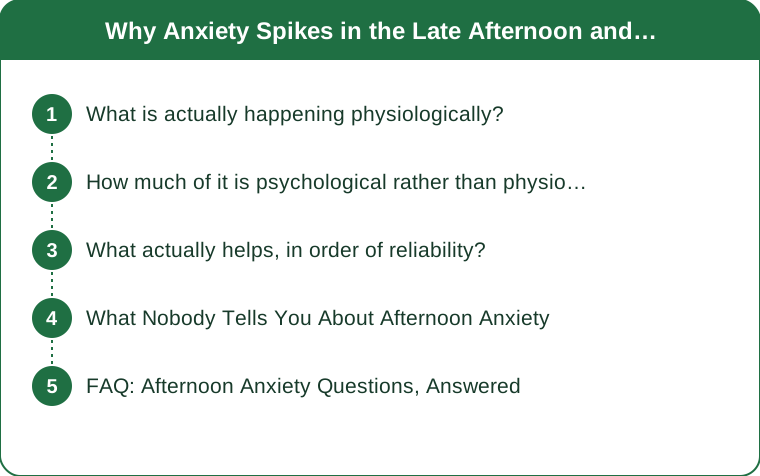
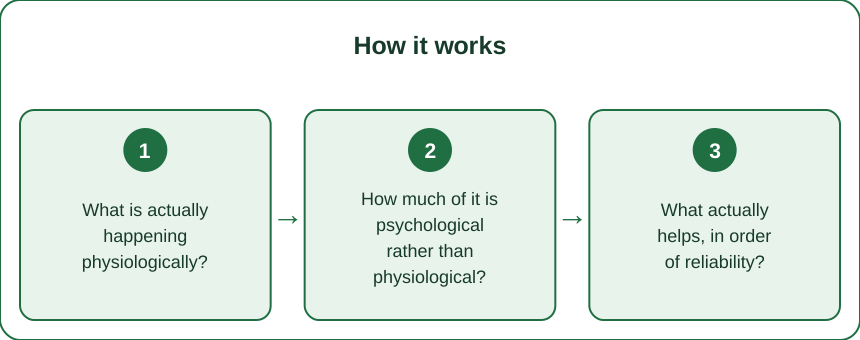
What is actually happening physiologically?
Several things converge, which is why it feels so much like a mood arriving from nowhere.
Cortisol has dropped. Cortisol follows a daily curve, peaking sharply within the first hour of waking and declining through the day. By mid-afternoon it is well down from that peak. Cortisol is not simply a stress hormone - it also supports alertness and blood sugar stability. As it falls, the buffering it provided falls too.
Blood sugar dips. For most people lunch is three to five hours behind by 4pm. If lunch was carbohydrate-heavy and light on protein, the dip is sharper. Falling blood glucose triggers adrenaline release, and adrenaline produces exactly the physical signature of anxiety - racing heart, tightness, restlessness, an edge of dread.
Caffeine is in its awkward phase. Caffeine has a half-life of roughly five to six hours, so a 10am coffee is at half strength around 4pm and declining. The declining phase is where jitteriness and unease are most reported, particularly if adenosine has been building all day.
Light is dropping. As afternoons shorten into autumn, the light in the late afternoon falls off noticeably. Light exposure influences alertness and mood directly, and the drop lands precisely in this window.
Sleep pressure is high. Adenosine has been accumulating since you woke. High sleep pressure with low cortisol produces a state that is both tired and wired - and that combination is very frequently experienced as anxiety rather than as fatigue.
How much of it is psychological rather than physiological?
A meaningful share, and it is not less real for being psychological.
The reckoning point. Mid-afternoon is when the day’s plan meets the day’s reality. In the morning there is still time. By 4pm, whatever has not been done is becoming a fact rather than a possibility, and the mind starts running the calculation.
Decision fatigue. Executive function degrades over a day of decisions. The same problem that felt manageable at 10am genuinely feels harder at 4pm, because the resource used to manage it has been spent.
The transition anticipation. For many people the late afternoon sits just before a shift - school pickup, the commute, the start of the evening’s demands. Anticipating a transition is its own low-grade stress, and it arrives before the transition does.
Reduced distraction. Morning is usually busy enough to occupy attention fully. As the pace drops, unresolved worries that were being crowded out have room to surface. This is the same reason anxiety often arrives at bedtime.
The pattern becomes self-fulfilling. Once you have noticed that 4pm feels bad, you start monitoring for it at 3:45. Anticipatory monitoring reliably increases the thing being monitored - which is why simply knowing the cause often reduces the intensity.

What actually helps, in order of reliability?
1. Eat something with protein around 3pm. This is the highest-return intervention and the most consistently skipped. A snack combining protein and some fat blunts the glucose dip and the adrenaline response that follows it. Greek yogurt, a handful of nuts with fruit, cheese and an oatcake, cottage cheese. Not a biscuit or a sweet coffee, which produces a sharper dip 45 minutes later.
2. Get outside for ten minutes. Daylight even on an overcast day is dramatically brighter than indoor lighting, and it supports both alertness and circadian timing. Combining it with a short walk covers two interventions at once, and this pairing is the most effective non-food option available.
3. Move for five minutes. Not a workout. Stairs, a brisk walk around the building, or twenty squats and some shoulder rolls. Movement metabolizes circulating adrenaline and interrupts the physical loop.
4. Write down what is unfinished. Two minutes, everything on your mind, unsorted. The anxiety is partly the cognitive load of holding open loops. Externalizing them reduces the load whether or not you do anything about them today.
5. Move the caffeine cut-off earlier. If afternoon anxiety is a regular feature, try no caffeine after 11am for a week. Many people find the afternoon changes substantially, and it also improves sleep, which feeds back into the whole picture.
6. Long exhale breathing. Six breaths with the exhale roughly twice the length of the inhale. This is the fastest acute intervention when you cannot leave your desk - it works within about a minute, though it treats the symptom rather than the cause.
7. Front-load the hard tasks. If the 4pm dread is partly about what has not been done, doing the worst task at 9am removes the fuel. Structural rather than physiological, and often the most durable fix.
What Nobody Tells You About Afternoon Anxiety
It is often hunger wearing a costume. The physical sensations of a blood sugar dip and of anxiety overlap almost completely - shakiness, racing heart, difficulty concentrating, irritability, a sense of unease. Many people have spent years treating a mid-afternoon snack requirement as a psychological problem.
Alcohol the night before lands here. Even a moderate amount disrupts sleep architecture and produces a rebound in the following day’s stress response, and mid-to-late afternoon is a common time for it to show up. If your worst afternoons follow your social evenings, that is the link.
It gets worse as the clocks change. The transition into autumn compresses afternoon light considerably, and for people sensitive to seasonal light changes the late-afternoon window is where it registers first - often weeks before anyone connects it to the season.
Cycle timing matters. Anxiety symptoms commonly intensify in the late luteal phase, and the afternoon dip can be noticeably sharper in that week. Tracking it for two cycles often reveals a pattern that reframes the whole experience.
Skipping lunch makes 4pm much worse, not better. People who work through lunch to get ahead very reliably pay for it in this window, and the productivity gained is usually less than the productivity lost.
It responds to routine more than to willpower. Because the causes are largely mechanical - food, light, movement, caffeine - the fix is a scheduled habit rather than a coping technique. A 3pm snack and a 3:15 walk, done automatically, outperforms managing the feeling when it arrives.
FAQ: Afternoon Anxiety Questions, Answered
How do I tell if it is blood sugar or genuine anxiety?
Test it. Eat a protein-containing snack at 3pm every day for a week and see what happens to the 4pm feeling. If it substantially improves, you have your answer cheaply. If nothing changes, look at the other contributors.
Should I stop drinking coffee entirely?
Not necessarily - try moving it earlier first. Most of the afternoon effect comes from the declining phase and from the interaction with accumulated sleep pressure. Morning-only caffeine solves this for a lot of people without giving it up.
Why does it happen on days off too?
The physiological drivers - cortisol curve, blood sugar, caffeine, light, sleep pressure - do not know it is Saturday. If anything, weekends often involve a later, more carbohydrate-heavy lunch and less structure, which can make it more pronounced.
Is a nap a good idea?
A short one - 10 to 20 minutes before 3pm - can help with the sleep pressure component. Longer or later naps risk grogginess and disrupted night sleep, which makes the following afternoon worse.
When should I take this to a doctor?
If the anxiety is severe, if it occurs throughout the day rather than in a window, if it comes with panic symptoms, or if it is affecting your ability to function. Thyroid problems, anaemia, blood sugar dysregulation, and perimenopausal changes all produce this presentation and are all worth ruling out.
This is general information, not medical advice.
TL;DR:
- Late-afternoon anxiety is stacked: falling cortisol, a blood sugar dip, declining caffeine, dropping light, high sleep pressure, and the day’s unfinished tasks becoming undeniable.
- A protein-containing snack at 3pm is the highest-return single fix, and the most commonly skipped.
- Ten minutes outside plus a short walk covers light and movement at once - the best non-food option.
- Two minutes writing down what is unfinished offloads the cognitive part.
- Try no caffeine after 11am for a week. Many people find it changes the whole window.
The feeling arrives without a trigger because the trigger is not an event - it is five mechanical things converging at the same hour. Which is good news, because mechanical causes have mechanical fixes.
Keep Reading
This article is for general informational and styling purposes only. Fit, sizing, and product availability may vary.