The Digital Sunset: Ending Screen Time Before It Ends Your Evening

Quick Answer: A digital sunset is a set time each evening — ideally an hour before bed — when screens go off and stay off. The biggest reason it works isn’t blue light; it’s that scrolling is stimulating, and stimulation is the opposite of what sleep needs. Move your charger out of the bedroom, automate the cutoff in your settings, and plan what replaces the hour. Thirty minutes counts.
The evening scroll advertises itself as rest. What it actually delivers is light, noise, and other people’s emergencies, injected directly into the hours built for winding down.
You know this. You’ve known it for years. The reason it hasn’t changed is that “use your phone less” isn’t a plan.
Why Does Screen Time Before Bed Actually Hurt?
Three layers, and the one everybody talks about is the least important.
The light layer. Evening screen light can delay melatonin release and push your body clock later. This is the argument everyone knows, and it’s real — but the effect from a phone at arm’s length is more modest than the “blue light” industry implies.
The arousal layer — the big one. The content is engineered to activate you. News, group chats, an algorithm optimized to hold your attention: all of it spikes exactly the alertness that sleep requires you to lose. The scroll is a stimulant that looks like rest. You can wear blue-light glasses and still be wide awake at midnight because you read something that made you angry at 10:40.
The displacement layer. The hour you scrolled is the hour you didn’t read, stretch, talk to someone, or sleep. It’s fake rest — it occupies the space that real rest was going to fill, without doing rest’s job.
The honest dose: a full screen-free hour before bed is the gold standard. Thirty minutes is a genuinely useful start. The perfect-or-nothing framing kills more digital sunsets than the phones ever do.
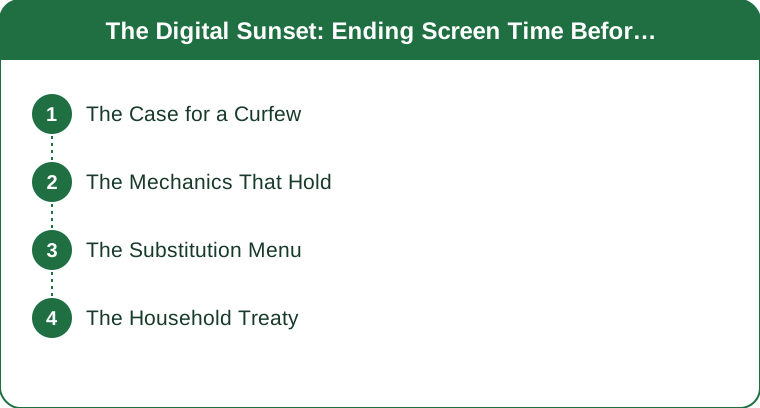
What Actually Makes a Phone Curfew Stick?
Distance, not discipline. Every reliable version of this comes down to making the phone physically harder to reach.
Move the charger out of the bedroom. This is the single highest-compliance intervention there is, and it’s a one-time decision rather than a nightly one. The “but it’s my alarm” objection costs about $12 to solve.
Let settings do the enforcing. Scheduled Do Not Disturb, an automatic greyscale switch at 9pm, app timers. Settings beat willpower at 10pm every single time, because willpower is the thing you have least of at 10pm.
Engineer the friction. A phone in a drawer in another room is three barriers away. A phone face-down on the nightstand is zero barriers away — face-down changes nothing. Distance is the entire game.
Keep an emergency clause. Starred contacts ring through. The curfew is aimed at the algorithm, not at your mother. Knowing an actual emergency can reach you is what makes the rest of it sustainable.
What Do You Do With the Hour Instead?
This is the part people skip, and it’s why most curfews collapse by week two. You cannot remove an hour of activity and replace it with nothing.
- Analog options. A paper book, a bath, a podcast with your eyes shut. The classics work because they’re low-stimulation by design.
- Hands-busy options. Knitting, sketching, a jigsaw, cooking something slow. People who take up a hands-busy hobby have by far the highest curfew success rate — it turns out the hand wanted something to do more than the brain did.
- The connection slot. An actual conversation with whoever else is in the house. The phone was displacing that, and getting it back is usually the most noticeable improvement.
- The body slot. Ten minutes of stretching, a body scan, a slow walk around the block. Every wind-down practice you’ve read about was waiting for exactly this hour to become available.
- Boredom. Staring at the ceiling for ten minutes is a legitimate activity. Boredom is the on-ramp to sleepiness — and the phone was blocking the exit.
5 Mistakes Everyone Makes
- Starting at a full hour. Begin at 20 or 30 minutes. Add ten minutes a week. A curfew you keep is worth more than an ambitious one you abandon on night four.
- Leaving the phone face-down on the nightstand. Zero friction. It’ll be in your hand in eleven minutes.
- Relying on willpower instead of settings. Automate it, or it won’t happen on the nights it matters most.
- Not planning the replacement. An empty hour with a phone in the house always resolves the same way.
- Going solo against a scrolling household. This is willpower on hard mode, and it’s the fifth mistake because it’s the one nobody expects to matter — see below.
How Do You Get the Household on Board?
A shared sunset beats a solo one, decisively. Couples and families who do it together enforce each other without anyone playing enforcer, and the reclaimed hour quietly becomes the best part of the day.
- Build a charging station ritual. One dock, one location, everyone’s devices, same time each night. The ceremony makes it feel normal rather than punitive.
- Remember the kids are watching. A parental curfew is the only screen rule children actually believe. Rules that apply to them alone teach them that screen limits are a punishment, not a practice.
- Write in a flexibility clause. Movie night exists. So do late calls with people in other time zones. Rigid rules break; rhythms bend and hold.
FAQ
How long before bed should you stop using screens?
An hour is the standard recommendation and the best target. Thirty minutes still produces a noticeable difference, and it’s far more likely to survive a real week. Start where you’ll actually keep it.
Do blue light glasses fix evening screen time?
Only partly. They address the light layer while leaving the arousal and displacement layers completely untouched — and those two do most of the damage. Glasses plus a scroll is still a scroll.
What if I use my phone as an alarm clock?
Buy a cheap alarm clock. It’s the smallest possible obstacle to the highest-leverage change on this list, and it removes the last reason the phone has to be in the room.
TL;DR
- Arousal, not blue light, is the main problem — the content is a stimulant dressed as rest.
- The charger leaves the bedroom. Highest-compliance change there is.
- Settings enforce it, because willpower is depleted by 10pm.
- Face-down on the nightstand is zero friction. Distance is the whole game.
- Plan the replacement hour — analog, hands-busy, conversation, body, or honest boredom.
- Do it together. A solo curfew in a scrolling household rarely survives.
- Thirty minutes counts. Perfect-or-nothing is what kills it.
Keep Reading
This article is for general informational and styling purposes only. Fit, sizing, and product availability may vary.