3 Breathing Techniques to Melt Away Stress
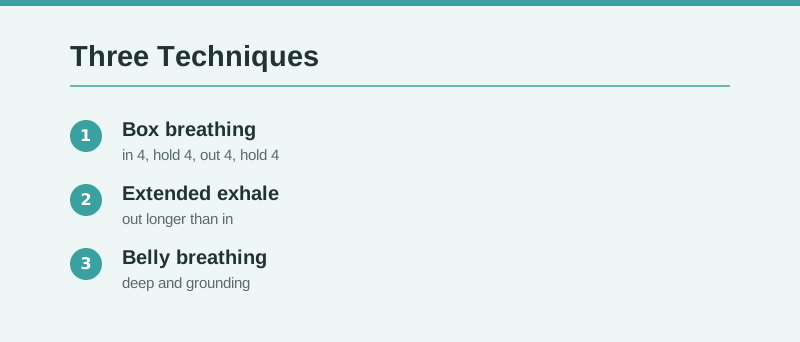
Quick Answer: Three techniques cover almost every stressful moment. Box breathing (in 4, hold 4, out 4, hold 4) steadies a racing mind. The extended exhale (in 4, out 6+) triggers your relaxation response and is invisible in public. Belly breathing (hand on stomach, breathe so it rises) grounds you when you feel scattered. Practise them calm so they’re available stressed.
The racing heart. The tight chest. The thoughts going in circles at 3 p.m. on a Tuesday.
You can’t leave the meeting. You don’t have an app open. There’s no quiet room.
You do have your breath — and it’s a genuine lever on your nervous system, not a wellness platitude.

1. Box breathing — for a racing mind
Inhale 4, hold 4, exhale 4, hold 4. Repeat for 4 to 6 rounds, which takes about a minute.
The even, predictable rhythm is what does the work. There’s nothing to decide and nothing to get wrong, which makes it usable at exactly the moments when your capacity to follow instructions is lowest.
Box breathing is widely used by athletes, military personnel and emergency responders for that reason — it’s simple enough to remember when your heart is going and your judgment isn’t at its best.
If four counts feels like a strain, use three. The pattern matters more than the number.
Best for: before a presentation, after bad news, when you can’t stop the thought loop.
2. The extended exhale — for invisible relief
Inhale for 4, exhale for 6 or more. That’s it.
This one has the clearest physiological rationale of the three. A longer exhale increases parasympathetic activity — your body’s rest-and-recover branch — which slows heart rate and eases tension within a few breaths. It’s the mechanism most of the other techniques are quietly using.
It’s also completely undetectable. You can do this in a meeting, on a train, mid-argument, or across a table from someone, and nobody will notice a thing. That makes it the most practically useful technique here by a wide margin.
Try 5 to 10 rounds. If 6 counts out feels short, push to 8 — but never to the point of straining, which defeats the purpose entirely.
Best for: anywhere with other people in the room.
3. Belly breathing — for feeling scattered
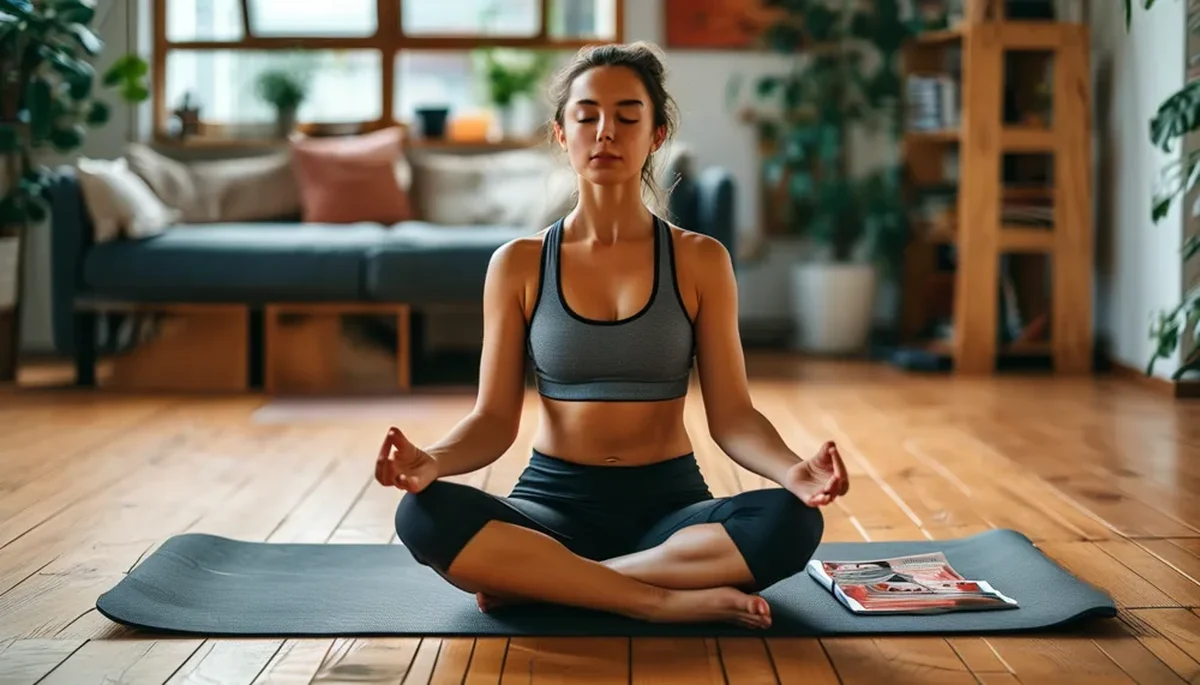
Place one hand on your stomach and one on your chest. Breathe slowly enough and deeply enough that the lower hand rises and the upper one barely moves.
Under stress most of us breathe shallowly into the upper chest, which is itself part of the stress response — the body reads that pattern as a signal that something’s wrong, and reinforces the state you’re trying to leave.
Belly breathing reverses the loop. Diaphragmatic breathing signals safety, and the physical feedback of feeling your hand rise gives a scattered mind something concrete to hold onto.
Aim for 8 to 10 slow breaths. Lying down makes it considerably easier if you’re learning it for the first time.
Best for: overwhelm, feeling ungrounded, winding down before bed.
What Nobody Tells You About Breathing Techniques
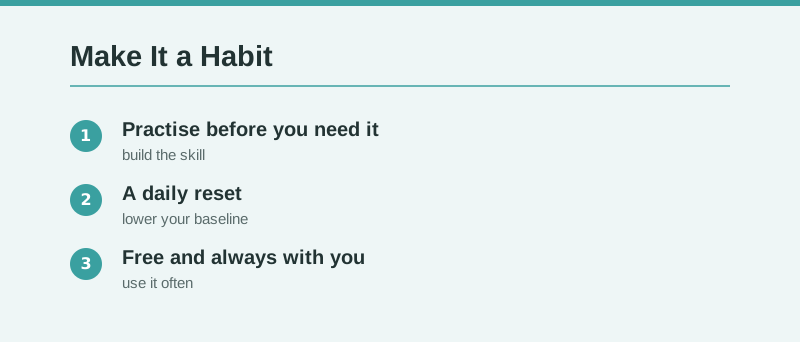
You have to practise them calm. A technique you’ve never used is not available to you at your worst moment. Do a round of box breathing while the coffee brews. Do extended exhales in bed. Then it’s a reflex rather than an instruction you have to remember.
Some people feel more anxious at first. Turning attention to your breath can heighten body awareness in a way that’s briefly uncomfortable, especially if you’re prone to panic. If that happens, keep your eyes open, breathe more gently, and try the extended exhale — it’s the least attention-demanding of the three.
Don’t force a bigger breath. Straining to inhale deeply can leave you light-headed. Slow and easy beats big every time — the goal is a longer breath, not a fuller one.
They work fast, but not instantly. Expect 30 to 90 seconds for a genuine shift. People often abandon a technique at 15 seconds and conclude it doesn’t work.
The effect compounds. A few minutes of intentional breathing daily lowers your baseline, so the stressful moments start from a lower rung. That’s the part you notice after a month rather than after a minute.
FAQ
Which breathing technique is best for anxiety?
The extended exhale, usually — it has the most direct physiological effect and requires the least concentration. Breathing techniques work best when they’re familiar, so pick one and practise it rather than rotating.
How long should I practise each day?
Two to five minutes is plenty and is enough to build the habit. Attaching it to something existing — after brushing your teeth, before your first email — makes it far more likely to stick.
Can breathing exercises replace treatment for anxiety?
No. They’re a genuinely useful tool for everyday stress and a helpful complement to treatment, but persistent anxiety, panic attacks or ongoing low mood deserve a conversation with a doctor or therapist.
TL;DR:
- Box breathing (4-4-4-4): a racing mind, 4–6 rounds.
- Extended exhale (in 4, out 6+): works anywhere, invisible, strongest physiological basis.
- Belly breathing (hand rises on the stomach): overwhelm and grounding, 8–10 breaths.
- Practise them calm so they’re available under stress.
- Allow 30–90 seconds to feel the shift; don’t force big breaths.
Your breath is free, always with you, and considerably more effective than it sounds. Pick one, practise it this week, and it’ll be there the next time you need it.
This article is for general wellness purposes and isn’t a substitute for professional medical or mental-health advice.
Keep Reading
This article is for general informational and styling purposes only. Fit, sizing, and product availability may vary.