A 5-Minute Meditation for Total Beginners

Quick Answer: Sit comfortably, close your eyes, and notice your breath for five minutes — returning your attention each time it wanders. That returning is the meditation, not a sign you’re doing it wrong. Five minutes daily builds more calm than a long session once a week, and it’s easier to keep going.
“My mind is too busy for meditation.”
Everyone’s is. That’s the raw material, not a disqualification.
And you don’t need twenty minutes, a cushion, or a quiet mountain. Five minutes and a chair will do it.

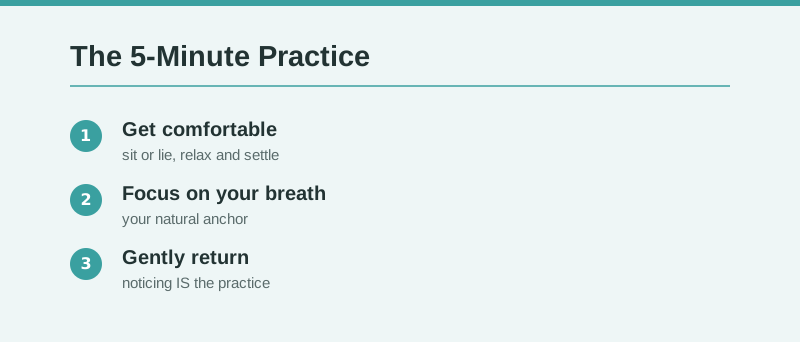
How do you start a 5-minute meditation?
Get comfortable first (30 seconds). A chair, cross-legged on the floor, or lying down — there’s no correct posture, only one where you can relax while staying reasonably alert. Feet flat if you’re in a chair, hands wherever they fall.
Close your eyes if that feels fine. If it doesn’t, let your gaze rest softly on the floor a metre or so ahead. Both work.
Then find the breath (the remaining 4½ minutes). Bring gentle attention to the sensation of breathing — the air at your nostrils, or the rise and fall at your belly. Don’t change it or deepen it. You’re observing, not managing.
Your breath is the anchor. Whenever you’re unsure what you’re supposed to be doing, the answer is: notice the breath. That’s the whole instruction.
Set a timer so you’re not wondering how long it’s been. Five minutes feels considerably longer than you’d expect, particularly around minute three.
What do you do when your mind wanders?
You notice, and you come back. And that’s the entire practice — this is the part most people miss.
Your mind will wander constantly. Ten seconds in, you’ll be thinking about an email. That is not failure. The noticing and returning is the meditation — the same way lowering the weight is part of the rep, not a break from it.
If it helps, silently label it: “thinking.” Then return.
A beginner might return thirty or forty times in five minutes. That’s thirty or forty successful repetitions of exactly the skill you’re building. A session with fewer returns isn’t a better session; it’s just a quieter day.

What Nobody Tells You About Your First Weeks
Your mind will seem busier, not calmer. It isn’t — you’re simply noticing traffic that was always there. This feels like the opposite of progress and is, reliably, a sign of it.
Minute three is where people quit. There’s a restless stretch where you become convinced the timer has broken. It passes, and sitting through it is where much of the benefit lives.
Self-judgment is the real obstacle. “I’m terrible at this” is a second distraction stacked on the first. Meet a wandering mind the way you’d meet a fidgety child — patiently, without a lecture — and the whole thing becomes considerably more pleasant.
The benefit shows up outside the session. Not during. Usually around week two or three, you notice a slightly longer gap between something annoying and your reaction to it. That’s the change worth having, and it never announces itself.
Falling asleep is common if you lie down. Sit upright in a chair if you want the alertness version.
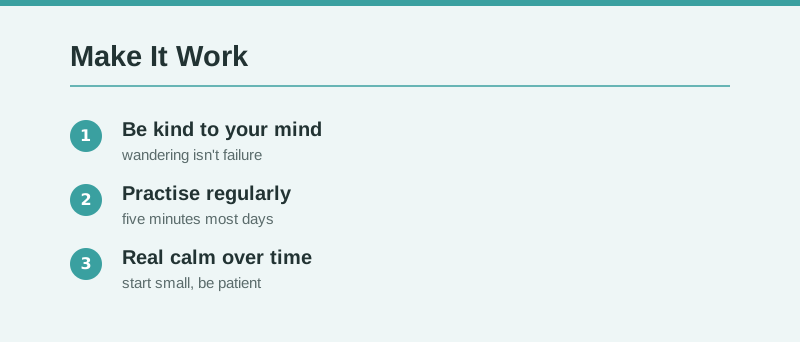
How do you make it stick?
Same time, every day. Attach it to a habit you already have — after you pour your first coffee, before you get into bed. The existing habit remembers for you, which matters more than motivation does.
Five minutes, most days, beats thirty minutes on Sunday. Frequency builds the skill; duration doesn’t, at least not at this stage. Nobody ever quit meditating because the sessions were too short.
Track days, not quality. A mark on a calendar. Rating sessions “good” or “bad” reintroduces exactly the judgment that makes people stop.
Guided audio is completely legitimate. A voice to follow makes the first few weeks much easier, and plenty of long-term practitioners still use it. It’s not the training wheels version.
Build up later if you want to — add two minutes a week rather than doubling. And on days when five feels impossible, sit for two. A short session keeps the habit alive; a skipped one restarts the negotiation.
FAQ
Is 5 minutes of meditation actually enough?
For building the habit and noticing everyday benefits, yes. Consistency does far more work than duration, and five minutes daily beats a long session once a week.
What if I can’t stop thinking?
You’re not meant to. Meditation is noticing and returning, not achieving a blank mind. A busy session with many returns is a productive one.
When’s the best time to meditate?
Morning tends to build the habit best, because fewer things have gone wrong yet. Evening tends to help more with winding down. Choose the one you’ll actually repeat.
TL;DR:
- Get comfortable, notice your breath, return when you drift. The returning is the practice.
- Set a timer for 5 minutes and don’t watch the clock.
- Your mind wandering forty times is forty reps, not forty failures.
- Same time daily, tracked as days not quality; guided audio is fine.
- Benefits show up outside the session, usually around week two or three.
Five minutes, most days, kindly. Start today and be patient with your wandering mind — it’s doing exactly what minds do, and returning is the only skill you need.
This article is for general wellness purposes and isn’t a substitute for professional medical or mental-health advice.
Keep Reading
This article is for general informational and styling purposes only. Fit, sizing, and product availability may vary.