A Simple 10-Minute Meditation Routine for Beginners

Quick Answer: A 10-minute beginner meditation is four steps: settle for 1 minute, notice your breath for 2, gently return your attention every time it wanders for 5, then ease out for 2. You’re not emptying your mind — noticing you drifted and coming back is the practice. Do it at the same time daily and it sticks in about two weeks.
You sit down. You close your eyes. Within eleven seconds you’re thinking about an email.
Most people take that as proof they “can’t meditate” and quit by day three.
It’s actually proof it’s working. That noticing — oh, I drifted — is the entire skill. Here’s the routine, minute by minute.

What is meditation, really?
Gently paying attention to the present — usually your breath — and kindly returning when your mind wanders.
That’s it. There’s no state to achieve, no blankness to reach, no correct number of thoughts. Meditation has a reputation for being mystical or reserved for people who can sit cross-legged for an hour, and that reputation keeps a lot of people from ever trying ten minutes of something quite ordinary.
Think of it like a bicep curl for attention. The wandering is the weight lowering. The returning is the lift. If your mind never wandered, you wouldn’t get any reps in.
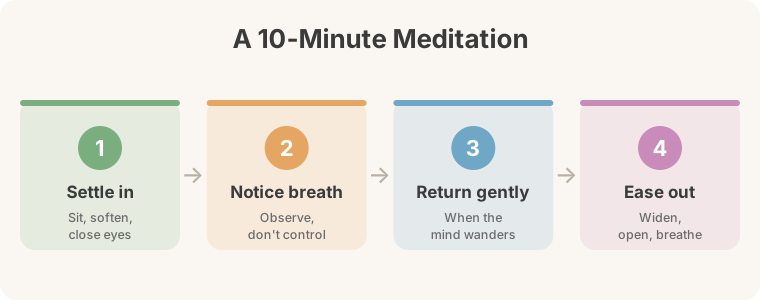
What does a 10-minute meditation routine look like?
Minutes 0–1: Settle in
Sit comfortably — chair or floor, both fine. Feet flat, hands resting wherever they land, shoulders soft. Close your eyes. Take a moment to simply arrive before you ask anything of yourself.
Minutes 1–3: Notice your breath
Breathe normally and bring your attention to the sensation of breathing — the cool air in, the warmer air out, the small rise at your ribs. Don’t control it. You’re an observer here, not a manager.
Minutes 3–8: Return, gently
Your mind will wander. Repeatedly. That’s expected and completely normal. Each time you notice, kindly guide your attention back to the breath. No frustration, no scorekeeping.
If it helps, silently label it — “thinking” — and return. Beginners often return 30 or 40 times in five minutes. That’s 40 successful reps, not 40 failures.
Minutes 8–10: Ease out
Let your attention widen to the sounds of the room, the feel of the chair, the light behind your eyelids. Slowly open your eyes. Take one full breath before you stand up and rejoin the day.
How do you actually build the habit?
- Start small. Ten minutes — or five — beats an ambitious hour you’ll never do. Nobody has ever quit meditating because the sessions were too short.
- Same time daily. Attach it to a habit you already have: after you pour your coffee, before you get into bed. The existing habit does the remembering for you.
- Same place, ideally. One chair that becomes “the meditation chair” removes a surprising amount of daily friction.
- Comfort matters. Somewhere quiet, in soft unrestrictive clothing, so your waistband isn’t the thing you end up noticing for ten minutes.
- Track days, not quality. A simple mark on a calendar. Judging sessions as “good” or “bad” is the fastest route to quitting.
What Nobody Tells You About Starting
Your mind will feel busier at first. It isn’t. You’re just noticing the traffic that was always there. This is genuinely a sign of progress, even though it feels like the opposite.
Ten minutes is longer than you think. Around minute four, most beginners get restless and convinced the timer is broken. It passes. Sitting through that specific stretch is where most of the benefit lives.
Falling asleep is common and fine. If it happens every time, sit upright in a chair rather than lying down, and try earlier in the day.
You won’t feel dramatic results on day one. Most people notice something around week two or three — usually a slightly longer pause between an irritation and their reaction to it. Nobody announces that in a testimonial, but it’s the change that matters most.
Guided audio is not cheating. A voice giving instructions is a completely legitimate way to learn, and many long-term meditators still use it.

Is 10 minutes a day actually enough?
For building the skill and feeling the everyday benefits, yes.
A regular short practice is associated with less reactivity to stress, better focus, and a calmer relationship with your own thoughts. Consistency beats intensity by a wide margin — ten minutes on most days does far more than a heroic hour every other Sunday.
If you want to grow it later, add two minutes a week rather than doubling. And if ten feels impossible some days, sit for three. A short session keeps the habit alive; a skipped one starts the negotiation over.
FAQ
What if I can’t stop thinking?
You’re not supposed to. The goal is noticing thoughts and returning, not eliminating them. A session with a hundred returns is a strong session.
Morning or evening — which is better?
Morning tends to build the habit more reliably because fewer things have gone wrong yet. Evening tends to help more with winding down. Pick whichever you’ll actually repeat.
Do I need an app or special cushion?
No. A chair and a phone timer are enough. Apps help with structure and streaks if you like that, but they’re optional.
TL;DR:
- Meditation = notice your breath, return kindly when you drift. The returning is the practice.
- 10-minute structure: 1 min settle, 2 min breath, 5 min return, 2 min ease out.
- Same time, same place, attached to an existing habit.
- Feeling busier at first is normal progress; results usually show around week two or three.
- Ten minutes most days beats an hour occasionally.
Settle, breathe, return, ease out. Start today, be kind to your wandering mind, and let consistency do the rest — ten quiet minutes is a genuinely good deal.
This article is for general wellness and informational purposes only and isn’t a substitute for professional medical or mental-health advice. If you’re dealing with persistent anxiety, low mood, or trauma-related distress, speak with a mental-health professional — meditation can be a useful complement to care, but it isn’t a replacement for it.
Keep Reading
This article is for general informational and styling purposes only. Fit, sizing, and product availability may vary.